
TFT LCD Display Module Manufacturing & OEM Integration
Our custom TFT LCD display modules are engineered for demanding industrial, medical, and automotive environments. We provide end-to-end OEM solutions, including high-brightness backlights, custom CTP (Capacitive Touch Panels), and rugged cover lenses to ensure reliable HMI performance.
TFT LCD Display Module for Harsh Industrial Environments
An industrial TFT LCD display module is a robust human-machine interface (HMI) built for extreme conditions. By utilizing precise optical bonding technologies (LOCA/OCA/OCR), we eliminate the internal air gap between the display and the touch glass. This ensures optimal clarity, prevents condensation, and guarantees a long lifespan (MTBF > 50,000 hours) for EV charging stations, outdoor kiosks, and heavy machinery.
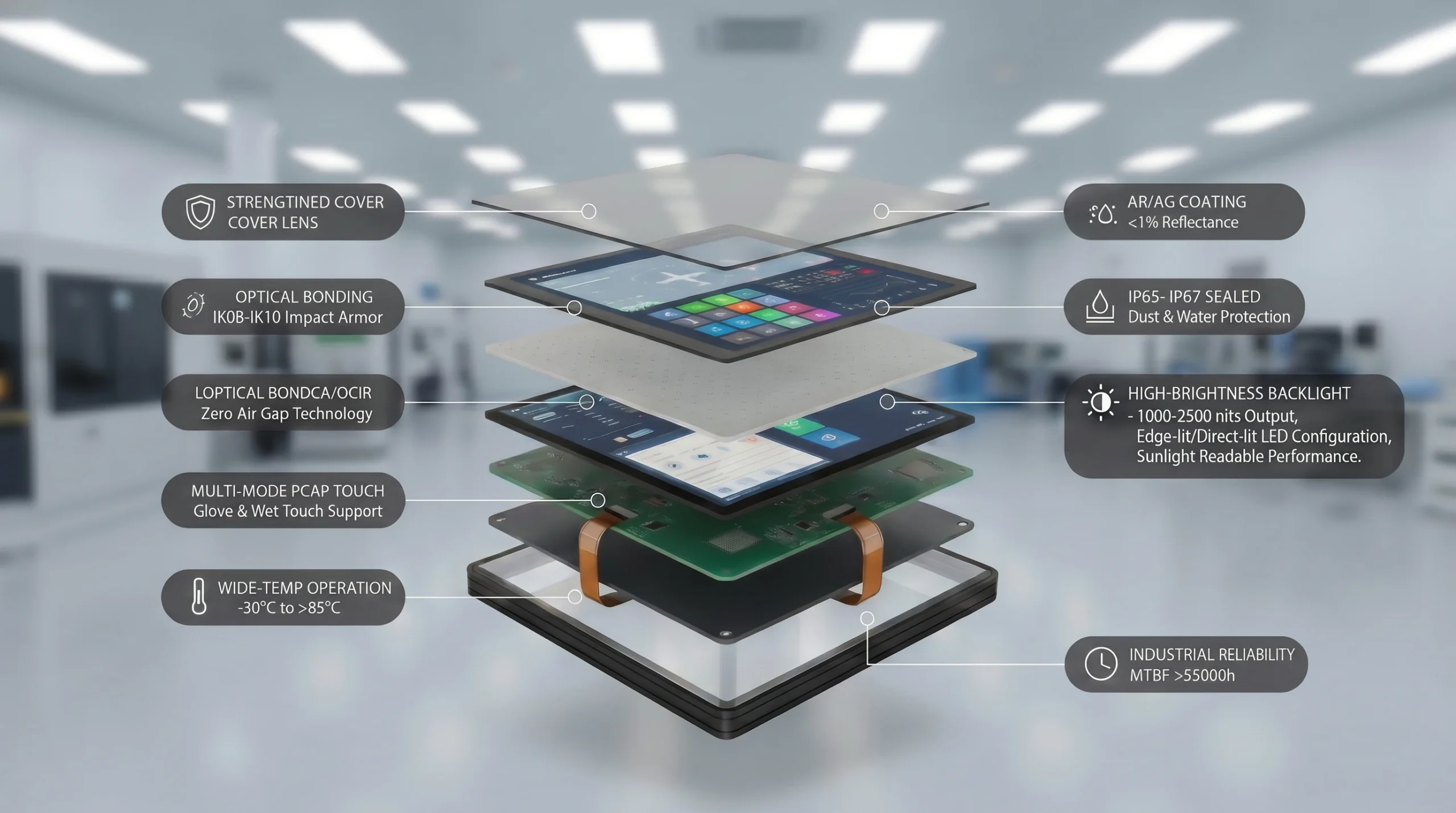
Why Choose Our Industrial TFT LCD Screens?
Our standardized, automated production lines ensure consistent execution of multi-layered optical configurations:
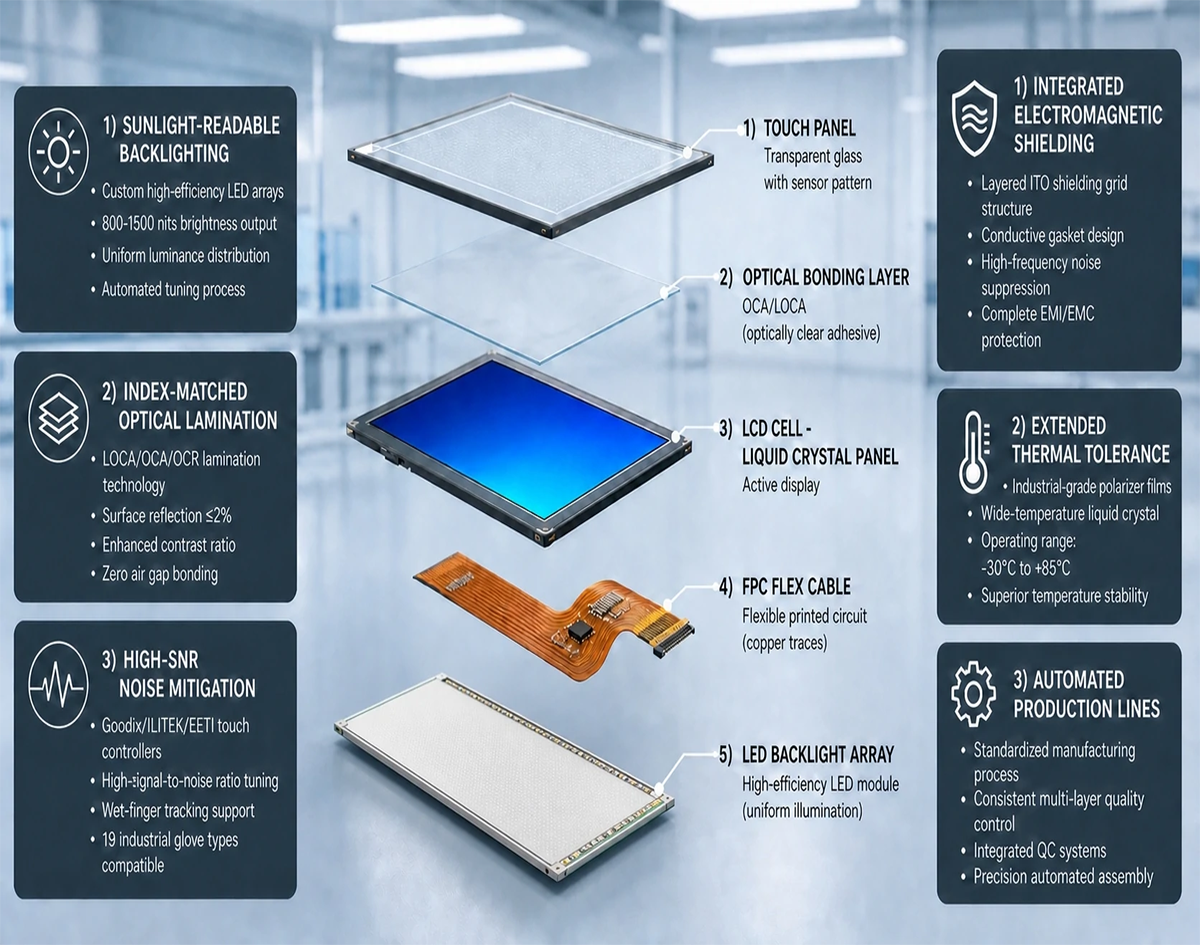
Sunlight-Readable Backlighting
Custom LED arrays delivering 800 to 1500 nits of high brightness for clear outdoor visibility.
Optical Lamination (OCA/OCR)
Advanced bonding reduces surface reflections to ≤2%, maximizing contrast and eliminating screen fogging.
Industrial Touch Support
Premium ICs (Goodix, ILITEK, EETI) enable precise multi-touch control, even with thick industrial gloves or wet hands.
Integrated EMI Shielding
Built-in ITO shielding grids safely block electromagnetic interference in complex factory environments.
Extended Thermal Tolerance
Industrial-grade materials ensure stable 7x24h operation in extreme temperatures from -30°C to +85°C.
Standard TFT LCD Display Module Configurations
| Item | Module Size (inch) | Display Color | Resolution | Active Area(mm) | Outline Dimension (W x H x D) | Interface | Luminance (cd/m2) | power supply mode | Operating temperature (℃) | Storage temperature (℃) |
| 1 | 0.32″ | White | 60 x 32 | 7.06*3.82 | 9.96*8.85*1.2 | I2C | 160(min) | Built-in | -40 ~ +70 | -40~+85 |
| 2 | 0.33″ | White | 32 x 62 | 8.42*4.82 | 13.68*6.93*1.25 | I2C | 220(min) | Built-in | -40 ~ +70 | -40~+85 |
| 3 | 0.35″ | White/Green | / | 8.18*3.2 | 12.1*6.0*1.2 | / | 120(min) | VEXT Voltage External | -40 ~ +70 | -40~+85 |
| 4 | 0.42″ | White | 72 x 40 | 11.0*7.5 | 12.0*11*1.25 | I2C/4-Wire SPI | 120(min) | Built-in | -40 ~ +70 | -40~+85 |
| 5 | 0.49″ | White/Blue | 64 x 32 | 11.18*5.58 | 14.5*11.6*1.2 | I2C/4-Wire SPI | 180(min) | Built-in | -40 ~ +70 | -40~+85 |
| 6 | 0.50″ | White | 48 x 88 | 6.124*11.244 | 8.928*17.1*1.227 | I2C/SPI | 250(min) | Built-in | -40 ~ +70 | -40~+85 |
| 7 | 0.54″ | White | 96 x 32 | 12.46*4.14 | 18.52*7.04*1.227 | I2C | 190(min) | Built-in | -40 ~ +70 | -40~+85 |
| 8 | 0.63″ | White | 120 x 28 | 15.58*3.62 | 21.54*6.62*1.22 | I2C | 220(min) | Built-in | -40 ~ +70 | -40~+85 |
| 9 | 0.66″ | White | 64 x 48 | 13.42*10.06 | 16.42*16.9*1.25 | Parallel / I2C/4-Wire SPI | 190(min) | Built-in | -40 ~ +70 | -40~+85 |
| 10 | 0.69″ | white | 96 x 16 | 17.26*3.18 | 26.3*8.0*1.25 | I2C | 200(min) | Built-in | -40 ~ +70 | -40~+85 |
| 11 | 0.69″ | white/Blue | 96 x 16 | 17.26*3.18 | 26.3*8.0*1.2 | I2C | 120(min) | Built-in | -40 ~ +70 | -40~+85 |
| 12 | 0.77″ | white | 64 x 128 | 9.26*17.26 | 12.13*23.6*1.2 | 4-Wire SPI | 180(min) | Built-in | -40 ~ +70 | -40~+85 |
| 13 | 0.87″ | white/Blue | 128 x 32 | 22.38*5.58 | 28.54*8.58*1.2 | I2C | 120(min) | Built-in | -40 ~ +70 | -40~+85 |
| 14 | 0.91″ | white/Blue | 128 x 32 | 22.384*5.584 | 30.0*11.5*1.2 | I2C | 150(min) | Built-in | -40 ~ +70 | -40~+85 |
| 15 | 0.96″ | white/Blue/Y&B | 128 x 64 | 21.74*10.86 | 24.74*16.6*1.45 | I2C/4-Wire SPI | 80(min) | Built-in | -40 ~ +70 | -40~+85 |
| 16 | 0.96″ | white/Blue/Y&B | 128 x 64 | 21.744*11.204 | 26.7*19.26*1.45 | Parallel / I2C/4-Wire SPI | 150(min) | Built-in | -40 ~ +70 | -40~+85 |
| 17 | 0.96″ | white | 64 x 128 | 10.86*21.74 | 14.0*28.0*1.22 | I2C/4-Wire SPI | 100(min) | Built-in | -40 ~ +70 | -40~+85 |
| 18 | 1.09″ | white | 64 x 128 | 10.86*25.58 | 14.0*31.96*1.22 | 4-Wire SPI | 120(min) | Built-in | -40 ~ +70 | -40~+85 |
| 19 | 1.12″ | white | 128 x 128 | 20.14*20.14 | 27.0*30.1*1.25 | Parallel / I2C/4-Wire SPI | 80(min) | Built-in | -40 ~ +70 | -40~+85 |
| 20 | 1.3″ | white | 64 x 128 | 14.7*29.42 | 17.1*35.8*1.41 | I2C/4-Wire SPI | 120(min) | VEXT Voltage External | -40 ~ +70 | -40~+85 |
| 21 | 1.3″ | white/Blue | 128 x 64 | 29.42*14.7 | 34.5*23.0*1.4 | Parallel / I2C/4-Wire SPI | 100(min) | Built-in | -40 ~ +70 | -40~+85 |
| 22 | 1.32″ | white | 128 x 96 | 26.86*20.14 | 32.5*29.2*1.61 | Parallel / I2C/4-Wire SPI | 100(min) | VEXT Voltage External | -40 ~ +70 | -40~+85 |
| 23 | 1.5″ | white/Yellow | 128 x 128 | 26.855*26.855 | 33.9*37.3*1.44 | Parallel / I2C/4-Wire SPI | 100(min) | VEXT Voltage External | -40 ~ +70 | -40~+85 |
| 24 | 1.54″ | white | 128 x 64 | 35.052*17.516 | 42.04*27.22*1.4 | Parallel / I2C/4-Wire SPI | 100(min) | VEXT Voltage External | -40 ~ +70 | -40~+85 |
| 25 | 1.71″ | white | 128 x 32 | 42.218*10.538 | 50.5*15.75*2.0 | Parallel / I2C/4-Wire SPI | 100(min) | VEXT Voltage External | -40 ~ +70 | -40~+85 |
| 26 | 1.92″ | white | 128 x 160 | 28.908*39.34 | 34.5*48.8*1.4 | Parallel / I2C/4-Wire SPI | 120(min) | VEXT Voltage External | -40 ~ +70 | -40~+85 |
| 27 | 2.32″ | white | 128 x 32 | 55.02*13.1 | 62.0*24.0*2.0 | Parallel / I2C/4-Wire SPI | 100(min) | VEXT Voltage External | -40 ~ +70 | -40~+85 |
| 28 | 2.42″ | white/Blue/Yellow | 128 x 64 | 55.01*27.49 | 60.5*37.0*1.8 | Parallel / I2C/4-Wire SPI | 100(min) | VEXT Voltage External | -40 ~ +70 | -40~+85 |
| 29 | 2.7″ | white/Blue/Yellow | 128 x 64 | 61.41*30.69 | 73.0*40.24*2.0 | Parallel / I2C/4-Wire SPI | 100(min) | VEXT Voltage External | -40 ~ +70 | -40~+85 |
| 30 | 3.12″ | white | 256 x 64 | 76.78*19.18 | 88.0*27.8*2.0 | Parallel / 4-Wire SPI | 80(min) | VEXT Voltage External | -40 ~ +70 | -40~+85 |
| 31 | 3.12″ | white/Blue/Yellow | 256 x 64 | 76.78*19.18 | 88.0*27.8*2.0 | Parallel / 4-Wire SPI | 80(min) | VEXT Voltage External | -40 ~ +70 | -40~+85 |
| Size | Part Number | Resolution | Outline Dimension(mm) | Interface | Luminance of White (cd/m2) | Backlight (LEDs) | LED Life Time(Hour) | Contrast Ratio | Operating temperature (℃) | Storage temperature (℃) |
| 2.0 | GD-240320T20P012A | 240 RGB(H) x 320 (V) | 35.90(H) x 48.65(V) x 2.75(D) | RGB/SPI | 1000cd/m2 | 5LEDs 75mA/5.8V | 50,000 | 800 | -20~+70 | -30~+80 |
| 2.0 | GD-240320T20P014A | 240 RGB(H) x 320 (V) | 35.90(H) x 48.65(V) x 2.8(D) | RGB/MCU/SPI | 1000cd/m2 | 5LEDs 75mA/5.8V | 50,000 | 800 | -20~+70 | -30~+80 |
| 2.0 | GD-320240T20N004B | 320 RGB(H) x 240 (V) | 45.80(H) x 39.82(V) x 2.55(D) | RGB/MCU/SPI | 1000cd/m2 | 4LEDs 160mA/3.0V | 50,000 | 1,500 | -20~+70 | -30~+80 |
| 2.1 | GD-480480T21N007A | 480 RGB(H) x 480 (V) | 0.111(H) x 0.111(V) | 3-SPI+18RGB | 400cd/m2 | 4EDs 80mA/3.2V | 50,000 | 1,000 | -30~+80 | -40~+90 |
| 2.1 | GD-480480T21N008A | 480 RGB(H) x 480 (V) | 0.111(H) x 0.111(V) | MIPI | 400cd/m2 | 4EDs 80mA/3.2V | 50,000 | 1,000 | -30~+80 | -40~+90 |
| 2.4 | GD-240320T24N028A | 240 RGB(H) x 320 (V) | 0.153(H) x 0.153(V) | RGB/MCU/SPI | 600cd/m2 | 4EDs 80mA/3.2V | 30,000 | 800 | -20~+70 | -30~+80 |
| 2.4 | GD-240320T24N033C | 240 RGB(H) x 320 (V) | 0.153(H) x 0.153(V) | RGB/MCU/SPI | 250cd/m2 | 4EDs 80mA/3.2V | 30,000 | 800 | -20~+70 | -30~+80 |
| 2.4 | GD-240320T24N045A | 240 RGB(H) x 320 (V) | 0.153(H) x 0.153(V) | RGB/MCU/SPI | 250cd/m2 | 4EDs 80mA/3.2V | 30,000 | 800 | -20~+70 | -30~+80 |
| 3.5″ | GD-320240T35N001A | 320RGB(H)*240(V) | 0.219(H) x 0.218(V) | RGB | 500cd/m2 | 6EDs 20mA/18.0V | 30,000 | 500 | -20~+70 | -30~+80 |
| 3.5″ | GD-320240T35P001G | 320RGB(H)*240(V) | 0.219(H) x 0.218(V) | RGB | 550cd/m2 | 6EDs 20mA/18.0V | 30,000 | 500 | -20~+70 | -30~+80 |
| 3.5″ | GD-320240T35N016A | 320RGB(H)*240(V) | 0.219(H) x 0.218(V) | RGB | 1000cd/m2 | 6EDs 20mA/18.0V | 30,000 | 500 | -20~+70 | -30~+80 |
| 3.5″ | GD-320480T35N034B | 320RGB(H)*480(V) | 0.153(H) x 0.153(V) | RGB/MCU/SPI | 300cd/m2 | 6EDs 20mA/18.0V | 30,000 | 700 | -20~+70 | -30~+80 |
| 3.5″ | GD-320480T35N040A | 320RGB(H)*480(V) | 0.153(H) x 0.153(V) | RGB/MCU/SPI | 300cd/m2 | 6EDs 120mA/3.0V | 30,000 | 500 | -30~+70 | -40~+85 |
| 3.5″ | GD-320480T35N045A | 320RGB(H)*480(V) | 0.153(H) x 0.153(V) | RGB/MCU/SPI | 300cd/m2 | 6EDs 120mA/3.0V | 30,000 | 500 | -20~+70 | -30~+80 |
| 3.5″ | GD-320480T35N047A | 320RGB(H)*480(V) | 0.153(H) x 0.153(V) | RGB/MCU/SPI | 600cd/m2 | 6EDs 120mA/3.0V | 30,000 | 1,000 | -20~+70 | -30~+80 |
| 3.5″ | GD-480640T35N005B | 480RGB(H)*640(V) | 0.1116(H) x 0.1116(V) | RGB/MCU/SPI | 120cd/m2 | 8EDs 20mA/24.0V | 30,000 | 300 | -20~+70 | -30~+80 |
| 3.5″ | GD-480800T35N022A | 480RGB(H)*800(V) | 0.0945(H) x0.0945(V) | RGB/MCU/SPI/MIPI | 500cd/m2 | 8EDs 20mA/24.0V | 30,000 | 10,000 | -20~+70 | -30~+80 |
| 3.5″ | GD-480800T35N025A | 480RGB(H)*800(V) | 0.0945(H) x0.0945(V) | MIPI | 500cd/m2 | 8EDs 20mA/24.0V | 30,000 | 10,000 | -20~+70 | -30~+80 |
| 3.9″ | GD-480128T39N001A | 480RGB(H)*128(V) | 0.198(H) x 0.198(V) | RGB | 1000 | 14LEDs 40mA/21V | 30,000 | 1,200 | -30~+85 | -30~+80 |
| 3.9″ | GD-800220T39N001A | 800RGB(H)*220(V) | 0.1188(H) x 0.1122(V) | RGB | 1000 | 10LEDs 40mA/15V | 30,000 | 1,200 | -30~+85 | -30~+80 |
| 3.6″ | GD-544506T36N001A | 544RGB(H)*506(V) | 0.165(H) x 0.165(V) | RGB | 1000 | 20LEDs 180mA/15V | 30,000 | -30~+85 | -30~+80 | |
| 3.95″ | GD-480480T40N006A | 480RGB(H)*480(V) | 0.1497(H) x 0.1462(V) | MIPI | 600 | 14LEDs 40mA/22.4V | 30,000 | 800 | -20~+70 | -30~+80 |
| 3.95″ | GD-480480T40N009B(INCELL) | 480RGB(H)*480(V) | 0.1497(H) x 0.1462(V) | MIPI | 600 | 12LEDs 40mA/18V | 30,000 | 900 | -20~+70 | -30~+80 |
| 3.98″ | GD-320480T40N001A | 320RGB(H)*480(V) | 0.174(H) x 0.174(V) | MCU/SPI/RGB | 350 | 8LEDs 160mA/3.2V | 30,000 | 900 | -20~+70 | -30~+80 |
| 3.97″ | GD-480800T40N011A | 480RGB(H)*800(V) | 0.108(H) x 0.108(V) | MIPI | 650 | 8LEDs 160mA/3.2V | 30,000 | 900 | -20~+70 | -30~+80 |
| 4.3″ | GD-480272T43N026A | 480RGB(H)*272(V) | 0.198(H) x 0.198(V) | RGB | 500 | 10LEDs 40mA/16V | 30,000 | 500 | -20~+70 | -30~+80 |
| 4.3″ | GD-480272T43N032C | 480RGB(H)*272(V) | 0.198(H) x 0.198(V) | RGB | 1000 | 16LEDs 40mA/24V | 30,000 | 500 | -20~+70 | -30~+85 |
| 4.3″ | GD-480272T43N033A | 480RGB(H)*272(V) | 0.198(H) x 0.198(V) | RGB | 500 | 10LEDs 40mA/16V | 30,000 | 800 | -30~+85 | -30~+85 |
| 4.3″ | GD-480272T43N033E | 480RGB(H)*272(V) | 0.198(H) x 0.198(V) | RGB | 1000 | 16LEDs 40mA/24V | 30,000 | 800 | -30~+85 | -30~+85 |
| 4.3″ | GD-480272T43N034A | 480RGB(H)*272(V) | 0.198(H) x 0.198(V) | RGB | 500 | 10LEDs 40mA/16V | 30,000 | 800 | -30~+85 | -30~+85 |
| 4.3″ | GD-480272T43N048A | 480RGB(H)*272(V) | 0.198(H) x 0.198(V) | RGB | 500 | 10LEDs 40mA/16V | 30,000 | 1,000 | -30~+85 | -30~+85 |
| 4.3″ | GD-800480T43N008C | 800RGB(H)*480(V) | 0.1188(H) x 0.1122(V) | RGB | 500 | 16LEDs 40mA/24V | 30,000 | 1,200 | -30~+85 | -30~+85 |
| 4.3″ | GD-800480T43N008G | 800RGB(H)*480(V) | 0.1188(H) x 0.1122(V) | RGB | 1000 | 16LEDs 40mA/24V | 30,000 | 1,200 | -30~+85 | -30~+85 |
| 4.3″ | GD-800480T43N011A | 800RGB(H)*480(V) | 0.1188(H) x 0.1122(V) | RGB | 1000 | 16LEDs 40mA/24V | 30,000 | 1,200 | -30~+85 | -30~+85 |
| 4.3″ | GD-800480T43N014A | 800RGB(H)*480(V) | 0.1188(H) x 0.1122(V) | LVDS | 500 | 10LEDs 40mA/16V | 30,000 | 1,200 | -30~+85 | -30~+85 |
| 4.3″ | GD-800480T43N014B | 800RGB(H)*480(V) | 0.1188(H) x 0.1122(V) | LVDS | 1000 | 16LEDs 40mA/24V | 30,000 | 1,200 | -30~+85 | -30~+85 |
| 4.3″ | GD-480800T43N022A | 480RGB(H)*800(V) | 0.117(H) x 0.117(V) | RGB | 500 | 9EDs 20mA/28.8V | 30,000 | 800 | -20~+70 | -30~+80 |
| 5″ | GD-800480T50N029H | 800RGB(H)*480(V) | 0.135*0.135 | RGB | 500 | 18LEDs 60mA/18V | 30,000 | 500 | -20‐+70 | -30‐+80 |
| 5″ | GD-800480T50N036A | 800RGB(H)*480(V) | 0.135*0.135 | RGB | 500 | 24LEDs 60mA/24V | 30,000 | 1,000 | -30~+85 | -30~+85 |
| 5″ | GD-800480T50N036B | 800RGB(H)*480(V) | 0.135*0.135 | RGB | 1000 | 24LEDs 60mA/24V | 30,000 | 1,000 | -30~+85 | -30~+85 |
| 5″ | GD-800480T50N037A | 800RGB(H)*480(V) | 0.135*0.135 | RGB | 500 | 24LEDs 60mA/24V | 30,000 | 1,000 | -30~+85 | -30~+85 |
| 5″ | GD-800480T50N037B | 800RGB(H)*480(V) | 0.135*0.135 | RGB | 1000 | 24LEDs 60mA/24V | 30,000 | 1,000 | -30~+85 | -30~+85 |
| 5″ | GD-800480T50N046A | 800RGB(H)*480(V) | 0.135*0.135 | LVDS | 500 | 24LEDs 60mA/24V | 30,000 | 1,000 | -30~+85 | -30~+85 |
| 5″ | GD-800480T50N047A(Reflective) | 800RGB(H)*480(V) | 0.135*0.135 | RGB | 200 | 12LEDs 40mA/18V | 30,000 | 60 | -20~+70 | -30~+80 |
| 5″ | GD-800480T50N057A | 800RGB(H)*480(V) | 0.135*0.135 | MIPI | 1000 | 24LEDs 60mA/24V | 30,000 | 1,000 | -30~+85 | -30~+85 |
| 5″ | GD-1024600T050N001A | 1024RGB(H)*600(V) | 0.15495*0.108 | LVDS | 1000 | 24LEDs 60mA/24V | 30,000 | 1,200 | -30~+85 | -30~+85 |
| 5″ | GD-1024600T050N002A | 1024RGB(H)*600(V) | 0.15495*0.108 | RGB | 1000 | 24LEDs 60mA/24V | 30,000 | 1,200 | -30~+85 | -30~+85 |
| 5″ | GD-10801080T50N001A | 1080RGB(H)*1080(V) | 0.1176*0.1176 | RGB | 350 | 6LEDs 20mA/37.2V | 30,000 | 1,300 | -20~+70 | -30~+80 |
| 5.6″ | GD-640480T56N001A | 640RGB(H)*480(V) | 00.1764(H) x 0.1764(V) | RGB | 200cd/m2 | 21LEDs 140mA/9.6V | 50,000 | 1,000 | -20~+70 | -30~+80 |
| 5.7″ | GD-320240T57N001A | 320RGB(H)*240(V) | 0.36*0.36 | RGB | 560 | 30LEDs 200mA/9.6V | 50,000 | -20~+70 | -30~+80 | |
| 5.7″ | GD-320240T57N001B | 320RGB(H)*240(V) | 0.36*0.36 | RGB | 500 | 28LEDs 60mA/22.4V | 50,000 | -20~+70 | -30~+80 | |
| 5.7″ | GD-320240T57N002A | 320RGB(H)*240(V) | 0.36*0.36 | RGB | 700 | Built-in PWM | 50,000 | -20~+70 | -30~+80 | |
| 5.7″ | GD-640480T57N002A | 640RGB(H)*480(V) | 0.18*0.18 | RGB | 500 | 21LEDs 140mA/9.6V | 50,000 | -30~+85 | -40~+85 | |
| 5.7″ | GD-640480T57N003A | 640RGB(H)*480(V) | 0.18*0.18 | RGB | 500 | Built-in PWM | 50,000 | -30~+85 | -40~+85 | |
| 5.7″ | GD-640480T57N004A | 640RGB(H)*480(V) | 0.18*0.18 | LVDS | 700 | 30LEDs 200mA/9.6V | 50,000 | -30~+85 | -40~+85 | |
| 5.7″ | GD-640480T57N004B | 640RGB(H)*480(V) | 0.18*0.18 | LVDS | 1100 | 30LEDs 200mA/9.6V | 50,000 | -30~+85 | -40~+85 | |
| 5.7″ | GD-640480T57N006B | 640RGB(H)*480(V) | 0.18*0.18 | LVDS | 1100 | 30LEDs 200mA/9.6V | 50,000 | -30~+85 | -40~+85 | |
| 5.7″ | GD-640480T57N008A | 640RGB(H)*480(V) | 0.18*0.18 | RGB | 1100 | 30LEDs 200mA/9.6V | 50,000 | -30~+85 | -40~+85 | |
| 6″ | GD-7201280T60N003A | 720RGB(H)*1280(V) | 0.10257*0.10257 | MIPI | 320 | 16LEDs 80mA/12V | 50,000 | 800 | -20~+70 | -30~+80 |
| 6″ | GD-7201280T60N003A-HDMI | 720RGB(H)*1280(V) | 0.10257*0.10257 | MIPI | 320 | 16LEDs 80mA/12V | 50,000 | 800 | -20~+70 | -30~+80 |
| 6.2″ | GD-360960T62N001A | 360RGB(H)*960(V) | 0.1536(H) x 0.1536(V) | 3spi+18RGB | 430 | 15LEDs 100mA/9V | 50,000 | 1,000 | -20~+60 | -30~+70 |
| 6.2″ | GD-640240T62N001A | 640RGB(H)*240(V) | 0.0775(H) x 0.0775(V) | RGB | 450 | 28LEDs 120mA/21V | 50,000 | 1,200 | -30~+85 | -35~+85 |
| 6.2″ | GD-640240T62N002A | 640RGB(H)*240(V) | 0.0775(H) x 0.0775(V) | LVDS | 450 | 28LEDs 120mA/21V | 50,000 | 1,200 | -30~+85 | -35~+85 |
| 6.7″ | GD-19201080T67N002A | 1920RGB(H)*1080(V) | 0.07725(H) x 0.07725(V) | LVDS | 1000 | 21LEDs 120mA/24V | 50,000 | 1,000 | -20~+70 | -30~+80 |
| 6.7″ | GD-19201080T67N004A | 1920RGB(H)*1080(V) | 0.07725(H) x 0.07725(V) | LVDS | 1000 | 30LEDs 240mA/15V | 50,000 | 1,200 | -30~+85 | -35~+85 |
| 6.5″ | GD-640480T65N001A | 640RGB(H)*480(V) | 0.207(H) x 0.207(V) | LVDS | 1200 | 12LEDs 100mA/18V | 50,000 | 800 | -30~+80 | -35~+80 |
| 6.4″ | GD-19201080T64N001A | 1024RGB(H)*768(V) | 0.126(H) x 0.126(V) | LVDS | 1300 | Built-in PWM | 50,000 | 800 | -20~+70 | -30~+80 |
| 6.86″ | GD-4801280T686N004A | 480RGB(H)*1280(V) | 0.12546(H) x 0.12546(V) | MIPI | 1000 | 12LEDs 240mA/9.6V | 50,000 | 900 | -20~+70 | -30~+80 |
| 6.85″ | GD-2801424T685N001A | 280RGB(H)*1424(V | 0.09525(H) × 0.09525(V) | SPI/RGB | 500 | 8LEDs 20mA/25.6V | 30,000 | 1,200 | -30~+80 | -40~+85 |
| 6.85″ | GD-2801424T685N002A | 280RGB(H)*1424(V | 0.09525(H) × 0.09525(V) | MIPI | 500 | 8LEDs 80mA/12V | 30,000 | 1,200 | -30~+80 | -40~+85 |
| TFT module size(inch) | Part Number | Display Mode | Resolution | Outline Dimension(mm) | Interface | Luminance of White(cd/㎡) | Backlight (LEDs) | LED Life Time(Hour) | Contrast Ratio | Operating Temperature (℃) | Storage Temperature (℃) |
| 7″ | GD-800600T70N002H | Normally White | 800 RGB(H) *480(V) | 165(W)*100(H)*5.7(D) | RGB | 1000 | 27 LEDs 270mA/9.6V | 50,000 | 800 | -20~+70 | -30~+80 |
| 7″ | GD-800600T70N045D | Normally White | 800 RGB(H) *480(V) | 165(W)*100(H)*5.7(D) | RGB | 500 | 27 LEDs 180mA/9.6V | 50,000 | 800 | -20~+70 | -30~+80 |
| 7″ | GD-800600T70N026B | Normally White | 800 RGB(H) *480(V) | 165(W)*100(H)*5.7(D) | RGB | 500 | 27 LEDs 180mA/9.6V | 50,000 | 800 | -20~+70 | -30~+80 |
| 7″ | GD-800480T70N072D | Normally White | 800 RGB(H) *480(V) | 165(W)*100(H)*5.7(D) | RGB | 1000 | Built-in PWM | 50,000 | 800 | -20~+70 | -30~+80 |
| 7″ | GD-800480T70N066A | Normally Black | 800 RGB(H) *480(V) | 165(W)*100(H)*5.7(D) | LVDS | 1300 | 28 LEDs 120mA/24V | 50,000 | 1,000 | -20~+70 | -30~+80 |
| 7″ | GD-800480T70N067A | Normally Black | 800 RGB(H) *480(V) | 165(W)*100(H)*5.7(D) | RGB | 1000 | 27 LEDs 270mA/9.6V | 50,000 | 1,000 | -20~+70 | -30~+80 |
| 7″ | GD-800480T70N097B | Normally Black | 800 RGB(H) *480(V) | 165(W)*100(H)*5.7(D) | MIPI | 1300 | 27 LEDs 270mA/9.6V | 50,000 | 1,000 | -20~+70 | -30~+80 |
| 7″ | GD-800480T70N056A | Normally White | 800 RGB(H) *480(V) | 165(W)*104.44(H)*5.2(D) | RGB | 500 | 18 LEDs 160mA/9.6V | 30,000 | 1,000 | -20~+70 | -30~+80 |
| 7″ | GD-800480T70N057A | Normally White | 800 RGB(H) *480(V) | 165(W)*104.44(H)*5.2(D) | RGB | 500 | Built-in PWM | 30,000 | 1,000 | -20~+70 | -30~+80 |
| 7″ | GD-800480T70N069A | Normally Black | 800 RGB(H) *480(V) | 165(W)*104.00(H)*5.5(D) | LVDS | 1000 | 30 LEDs 250mA/18V | 50,000 | 1,000 | -30~+85 | -40~+95 |
| 7″ | GD-800480T70N079A | Normally Black | 800 RGB(H) *480(V) | 165(W)*104.00(H)*5.5(D) | LVDS | 1000 | 30 LEDs 250mA/18V | 50,000 | 1,000 | -30~+85 | -40~+95 |
| 7″ | GD-800480T70N086A | Normally Black | 800 RGB(H) *480(V) | 165(W)*104.00(H)*5.5(D) | RGB | 500 | 18 LEDs 160mA/9.6V | 50,000 | 1,000 | -30~+85 | -40~+95 |
| 7″ | GD-800480T70N087A | Normally Black | 800 RGB(H) *480(V) | 165(W)*104.00(H)*5.5(D) | RGB | 500 | Built-in PWM | 50,000 | 1,000 | -30~+85 | -40~+95 |
| 7″ | GD-1024600T70N071A | Normally Black | 1024 RGB(H) *600(V) | 165(W)*100(H)*2.8(D) | RGB | 1000 | 27 LEDs 270mA/9.6V | 30,000 | 1,000 | -30~+80 | -30~+85 |
| 7″ | GD-1024600T70N071D | Normally Black | 1024 RGB(H) *600(V) | 165(W)*100(H)*5.7(D) | RGB | 1000 | 27 LEDs 270mA/9.6V | 30,000 | 1,000 | -30~+80 | -30~+85 |
| 7″ | GD-1024600T70N066A | Normally Black | 1024 RGB(H) *600(V) | 165(W)*100(H)*3.5(D) | LVDS | 1000 | 27 LEDs 270mA/9.6V | 30,000 | 1,000 | -30~+80 | -30~+85 |
| 7″ | GD-1024600T70N066B | Normally Black | 1024 RGB(H) *600(V) | 165(W)*100(H)*2.8(D) | LVDS | 1000 | 27 LEDs 270mA/9.6V | 30,000 | 1,000 | -30~+80 | -30~+85 |
| 7″ | GD-1024600T70N066D | Normally Black | 1024 RGB(H) *600(V) | 165(W)*100(H)*5.7(D) | LVDS | 1000 | 27 LEDs 270mA/9.6V | 30,000 | 1,000 | -30~+80 | -30~+85 |
| 7″ | GD-1024600T70N040D | Normally Black | 1024 RGB(H) *600(V) | 165(W)*100(H)*5.7(D) | MIPI | 1000 | 27 LEDs 270mA/9.6V | 30,000 | 1,000 | -30~+80 | -30~+85 |
| 7″ | GD-1024600T70N091D | Normally Black | 1024 RGB(H) *600(V) | 165(W)*100(H)*5.7(D) | LVDS | 1000 | Built-in PWM | 30,000 | 1,000 | -30~+80 | -30~+85 |
| 7″ | GD-1024600T70N086A | Normally Black | 1024 RGB(H) *600(V) | 165(W)*100(H)*5.7(D) | LVDS | 1000 | Built-in PWM | 30,000 | 1,000 | -30~+80 | -30~+85 |
| 7″ | GD-7201280T70N001A | Normally Black | 720 RGB(H) *1280V) | 98.61(W)*165.45(H)*3.27(D) | MIPI | 600 | 18LEDs 60mA/19.6V | 30,000 | 800 | -20~+70 | -30~+80 |
| 7″ | GD-8001280T70N001A | Normally Black | 800 RGB(H) *1280V) | 99.85(W)*161.70(H)*2.6(D) | MIPI | 400 | 20LEDs 80mA/15V | 30,000 | 1,000 | -20~+70 | -30~+80 |
| 7″ | GD-12001920T70N001A | Normally Black | 1200 RGB(H) *1290V) | 111.00(W)*166.00(H)*3.26(D) | MIPI | 1500 | 56LEDs 290mA/22.4V | 30,000 | 900 | -20~+70 | -30~+80 |
| 7″ | GD-10801920T70N001A | Normally Black | 1080 RGB(H) *1290V) | 89.33(W)*160.70(H)*1.39(D) | MIPI | 450 | 21LEDs 60mA/18.9V | 30,000 | 100 | -0~+50 | -20~+60 |
| 8″ | GD-800600T80N001E | Normally White | 800 RGB(H) * 600(V) | 182.9(W)*141.0(H)*6.25(D) | RGB | 500 | 30 LEDs 250mA/9.0V | 30,000 | 1,000 | -20~+70 | -30~+80 |
| 8″ | GD-800600T80N001E-LC-A | Normally White | 800 RGB(H) * 600(V) | 182.9(W)*141.0(H)*6.25(D) | LVDS | 500 | Built-in PWM | 30,000 | 1,000 | -20~+70 | -30~+80 |
| 8″ | GD-800600T80N001F | Normally White | 800 RGB(H) * 600(V) | 182.9(W)*141.0(H)*6.25(D) | RGB | 1000 | 30 LEDs 450mA/9.0V | 30,000 | 1,000 | -20~+70 | -30~+80 |
| 8″ | GD-800600T80N004 | Normally Black | 800 RGB(H) * 600(V) | 182.9(W)*141.0(H)*5.5(D) | RGB | 500 | 30 LEDs 250mA/9.0V | 30,000 | 1,000 | -20~+70 | -30~+80 |
| 8″ | GD-1024768T80N002A | Normally Black | 1024 RGB(H) * 768(V) | 182.9(W)*141.0(H)*5.5(D) | LVDS | 1000 | 27 LEDs 200mA/27.0V | 30,000 | 800 | -20~+70 | -30~+80 |
| 8″ | GD-8001280T80N009A1 | Normally Black | 800 RGB(H) * 1280(V) | 111.66(W)*184.16(H)*2.47(D) | MIPI | 550 | 32 LEDs 160mA/12.6V | 30,000 | 1,500 | -20~+70 | -30~+80 |
| 8″ | GD-12001920T80N008A | Normally Black | 1200 RGB(H) * 1920(V) | 121.34(W)*185.2(H)*4.7(D) | MIPI | 1500 | 40 LEDs 560mA/15V | 30,000 | 1,000 | -20~+70 | -30~+80 |
| 8″ | GD-19201200T80N001A | Normally Black | 1920 RGB(H) * 1200(V) | 181.70(W)*119.8(H)*5.5(D) | MIPI | 1000 | 36 LEDs 360mA/18V | 30,000 | 1,200 | -20~+70 | -30~+80 |
| 9″ | GD-800480T90N007 | Normally White | 800 RGB(H) * 480(V) | 210.9(H) x 126.5(V) x 5.3(D) | RGB | 350 | 30LEDs 200mA/9.0V | 30,000 | 800 | -20~+70 | -30~+80 |
| 9″ | GD-800480T90N007-LB | Normally White | 800 RGB(H) * 480(V) | 210.9(H) x 126.5(V) x 5.3(D) | LVDS | 350 | Built-in PWM | 30,000 | 800 | -20~+70 | -30~+80 |
| 9″ | GD-800480T90N006A | Normally White | 800 RGB(H) * 480(V) | 210.9(H) x 126.5(V) x 5.3(D) | RGB | 350 | 30LEDs 200mA/9.0V | 30,000 | 800 | -20~+70 | -30~+80 |
| 9.3″ | GD-6001600T93N001A | Normally White | 600 RGB(H) * 1600(V) | 231.00(H) x 89.00(V) x 7.3(D) | MIPI | 450 | 18LEDs 120mA/18.6V | 30,000 | 1,200 | -20~+70 | -30~+80 |
| 10.1″ | GD-1280800T101N034A | Normally Black | 1280 RGB(H) x 800 (V) | 229.64(H) x 149.1(V) x 3.0(D) | LVDS | 500cd/m2 | Built-in PWM | 50,000 | 1,000 | -20~+70 | -30~+80 |
| 10.1″ | GD-1280800T101N035A | Normally Black | 1280 RGB(H) x 800 (V) | 229.64(H) x 149.1(V) x 3.0(D) | MIPI | 500cd/m2 | Built-in PWM | 50,000 | 1,000 | -20~+70 | -30~+80 |
| 10.1″ | GD-1280800T101N036A | Normally Black | 1280 RGB(H) x 800 (V) | 229.64(H) x 149.1(V) x 3.0(D) | LVDS | 500cd/m2 | Built-in PWM | 50,000 | 1,000 | -20~+70 | -30~+80 |
| 10.1″ | GD-1280800T101N042A | Normally Black | 1280 RGB(H) x 800 (V) | 229.64(H) x 149.1(V) x 3.0(D) | LVDS | 500cd/m2 | 39LEDs 260mA/9.0V | 50,000 | 1,000 | -20~+70 | -30~+80 |
| 10.1″ | GD-1280800T101N055A | Normally Black | 1280 RGB(H) x 800 (V) | 229.64(H) x 149.1(V) x 3.0(D) | eDP | 500cd/m2 | Built-in PWM | 50,000 | 1,000 | -20~+70 | -30~+80 |
| 10.1″ | GD-1280800T101N057B | Normally Black | 1280 RGB(H) x 800 (V) | 229.8(H) x 149.0(V) x 5.9(D) | LVDS | 1200cd/m2 | Built-in PWM | 50,000 | 1,000 | -30~+80 | -40~+85 |
| 10.1″ | GD-1280800T101N058B | Normally Black | 1280 RGB(H) x 800 (V) | 229.8(H) x 149.0(V) x 5.9(D) | MIPI | 1200cd/m2 | Built-in PWM | 50,000 | 1,000 | -30~+80 | -40~+85 |
| 10.1″ | GD-1280800T101N059B | Normally Black | 1280 RGB(H) x 800 (V) | 229.8(H) x 149.0(V) x 5.9(D) | LVDS | 1200cd/m2 | Built-in PWM | 50,000 | 1,000 | -30~+80 | -40~+85 |
| 10.1″ | GD-1024600T101N046A | Normally Black | 1024 RGB(H) x 600 (V) | 235.0(H) x 143.0(V) x 4.5(D) | LVDS | 500cd/m2 | 39LEDs 390mA/9.0V | 50,000 | 1,000 | -30~+80 | -30~+80 |
| 10.1″ | GD-1024600T101N048A | Normally Black | 1024 RGB(H) x 600 (V) | 235.0(H) x 143.0(V) x 4.5(D) | RGB | 500cd/m2 | 39LEDs 390mA/9.0V | 50,000 | 1,000 | -30~+80 | -30~+80 |
| 10.1″ | GD-1024600T101N051A | Normally Black | 1024 RGB(H) x 600 (V) | 235.0(H) x 143.0(V) x 4.5(D) | LVDS | 500cd/m2 | Built-in PWM | 50,000 | 1,000 | -30~+80 | -30~+80 |
| 10.1″ | GD-1024600T101N052A | Normally Black | 1024 RGB(H) x 600 (V) | 235.0(H) x 143.0(V) x 4.5(D) | RGB | 500cd/m2 | 39LEDs 390mA/9.0V | 50,000 | 1,000 | -30~+80 | -30~+80 |
| 10.1″ | GD-8001280T101N008D2 | Normally Black | 800RGB(H) x 1280 (V) | 143.0(H) x228.60(V) x2.6(D) | MIPI | 250cd/m2 | 27LEDs 180mA/9.0V | 50,000 | 1,000 | -20~+70 | -30~+80 |
| 10.1″ | GD-8001280T101N008H | Normally Black | 800RGB(H) x 1280 (V) | 143.0(H) x228.60(V) x2.6(D) | MIPI | 500cd/m2 | 30LEDs 200mA/9.0V | 50,000 | 1,000 | -20~+70 | -30~+80 |
| 10.1″ | GD-19201200T101N005A | Normally Black | 1920RGB(H) x 1200 (V) | 229.46(H) x 149.1(V) x 4.8(D) | LVDS | 1000cd/m2 | 40LEDs 240mA/9.6V | 50,000 | 1,200 | -20~+70 | -30~+80 |
| 10.1″ | GD-19201080T101N001A | Normally Black | 1920RGB(H) x 1080 (V) | 229.46(H) x 149.1(V) x 4.8(D) | LVDS | 350cd/m2 | 36LEDs 180mA/24VV | 50,000 | 900 | -10~+50 | -30~+70 |
| 10.4″ | GD-800600T104N001A | Normally White | 800 RGB(H) * 600 (V) | 228.4(H) * 175.4(V) * 6.0(D) | RGB | 600 | 36LEDs 350mA/8.7V | 30,000 | 800 | -20~+70 | -30~+80 |
| 10.4“ | GD-800600T104N001B | Normally White | 800 RGB(H) * 600 (V) | 228.4(H) * 175.4(V) * 6.0(D) | RGB | 1000 | 42LEDs 800mA/9.6V | 30,000 | 800 | -20~+70 | -30~+80 |
| 10.4“ | GD-800600T104N001B-LB | Normally White | 800 RGB(H) * 600 (V) | 228.4(H) * 175.4(V) * 6.0(D) | LVDS | 1000 | Built-in PWM | 30,000 | 800 | -20~+70 | -30~+80 |
| 10.4“ | GD-1024100T104N002B-T | Normally White | 1024 RGB(H) * 100 (V) | 274.92(H) * 30.0(V) * 4.2(D) | RGB | 1000 | 24LEDs 80mA/19.2V | 50,000 | 500 | -20~+70 | -30~+80 |
| 10.4“ | GD-1024768T104N001C | Normally Black | 1024 RGB(H) * 600 (V) | 238.6(H) * 175.8(V) * 5.75(D) | LVDS | 1000 | Built-in PWM | 50,000 | 1,000 | -30~+80 | -30~+80 |
| 11.6″ | GD-19201080T116N002A | Normally Black | 1920 RGB(H) * 1080 (V) | 263.4(H) * 157.82(V) * 2.55(D) | eDP | 350 | 40LEDs 100mA/25.6V | 30,000 | 1,000 | 0~+50 | -10~+60 |
| 12.1″ | GD-1024768T121N003A | Normally Black | 1024 RGB(H) * 768 (V) | 260.48(H) * 204.0(V) * 7.2(D) | LVDS | 1000 | Built-in PWM | 50,000 | 1,000 | -30~+80 | -30~+80 |
| 12.1“ | GD-1280800T121N002D | Normally Black | 1280 RGB(H) * 800 (V) | 277.7(H) * 108.6(V) * 6.1(D) | LVDS | 1000 | Built-in PWM | 50,000 | 1,200 | -30~+80 | -30~+80 |
| 12.1“ | GD-1280800T121N005A | Normally Black | 1280 RGB(H) * 800 (V) | 277.7(H) * 108.6(V) * 6.1(D) | MIPI | 1000 | Built-in PWM | 50,000 | 1,200 | -30~+80 | -30~+80 |
| 12.3″ | GD-1920720T123N006A | Normally Black | 1920 RGB(H) ×720 (V) | 302.06(H) * 125.46(V) * 6.35(D) | LVDS | 1000 | 40LEDs 450mA/24V | 30,000 | 1,200 | -20~+70 | -30~+80 |
| 12.8″ | GD-19201080T128N001A | Normally Black | 1920 RGB(H) ×1080 (V) | 294.4(H) * 175.0(V) * 6.5(D) | LVDS | 700 | 48LEDs 380mA/38.4V | 50,000 | 1,500 | -30~+85 | -40~+90 |
| 13.3″ | GD-19201080T133N011A | Normally Black | 1920 RGB(H) ×1080 (V) | 307.6(H) * 183.05(V) * 5.4(D) | eDP | 500 | 54LEDs 420mA/27V | 30,000 | 800 | -20~+70 | -30~+80 |
| 14″ | GD-19201080T14N001A | Normally Black | 1920 RGB(H) ×1080 (V) | 315.87(H) * 197.11(V) * 2.8(D) | eDP | 300 | 45LEDs 100mA/27V | 30,000 | 1,200 | -0~+50 | -20~+60 |
| 15″ | GD-1024768T15N001A | Normally White | 1024 RGB(H) ×768 (V) | 362.5(H) * 253.5(V) * 11.8(D) | LVDS | 300 | Built-in PWM | 50,000 | 800 | -20~+70 | -30~+80 |
| 15″ | GD-1024768T15N001B | Normally White | 1024 RGB(H) ×768 (V) | 362.5(H) * 253.5(V) * 11.8(D) | LVDS | 450 | Built-in PWM | 50,000 | 800 | -20~+70 | -30~+80 |
| 15.6” | GD-19201080T156N016D | Normally Black | 1920 RGB(H) ×1080 (V) | 360.0(H) * 212.3(V) * 5.57(D) | LVDS | 800 | Built-in PWM | 50,000 | -30~+70 | -30~+80 | |
| 15.6” | GD-19201080T156N017A | Normally Black | 1920 RGB(H) ×1080 (V) | 362.66(H) * 214.76(V) * 7.38(D) | LVDS | 1000 | Built-in PWM | 50,000 | -30~+70 | -30~+80 | |
| 17.3” | GD-19201080T173N001A | Normally Black | 1920 RGB(H) ×1080 (V) | 389.888(H) * 227.012(V) * 3.5(D) | eDP | 250 | Built-in PWM | 15,000 | 800 | 0~50 | -20~+60 |
| 17.3” | GD-19201080T173N002A | Normally Black | 1920 RGB(H) ×1080 (V) | 388.888(H) * 225.812(V) * 4.0(D) | LVDS | 500 | Built-in PWM | 30,000 | 1,700 | -20~+60 | -20~+60 |
| 18.5″ | GD-19201080T185N001A | Normally Black | 1920 RGB(H) ×1080 (V) | 418.02(H) * 243.9(V) * 3.1(D) | LVDS | 300 | 56LEDs 260mA/42V | 30,000 | 1,000 | 0~50 | -20~+60 |
| 18.5″ | GD-19201080T185N002A | Normally Black | 1920 RGB(H) ×1080 (V) | 430.37(H) * 254.6(V) * 8.66(D) | eDP | 1,000 | 112LEDs 520mA/42V | 30,000 | 1,000 | 0~50 | -20~+60 |
| 18.5″ | GD-19201080T185N003A | Normally Black | 1920 RGB(H) ×1080 (V) | 418.02(H) * 243.9(V) * 3.2(D) | eDP | 270 | Built-in PWM | 30,000 | 1,000 | 0~50 | -20~+60 |
| 18.5″ | GD-19201080T185N004A | Normally Black | 1920 RGB(H) ×1080 (V) | 430.37(H) * 254.6(V) * 11.2(D) | LVDS | 500 | 65LEDs 320mA/39V | 30,000 | 1,000 | 0~50 | -20~+60 |
| 21.5″ | GD-19201080T215N002A | Normally Black | 1920 RGB(H) ×1080 (V) | 497.6(H) * 292.2(V) * 10.6(D) | LVDS | 500 | Built-in PWM | 50,000 | 1,000 | -10~+60 | -20~+60 |
| 23.8″ | GD-19201080T238N002A | Normally Black | 1920 RGB(H) ×1080 (V) | 543.08(H) * 316.72(V) * 8.3(D) | LVDS | 600 | 85LEDs 375mA/51V | 30,000 | 1,000 | -0~+50 | -20~+60 |
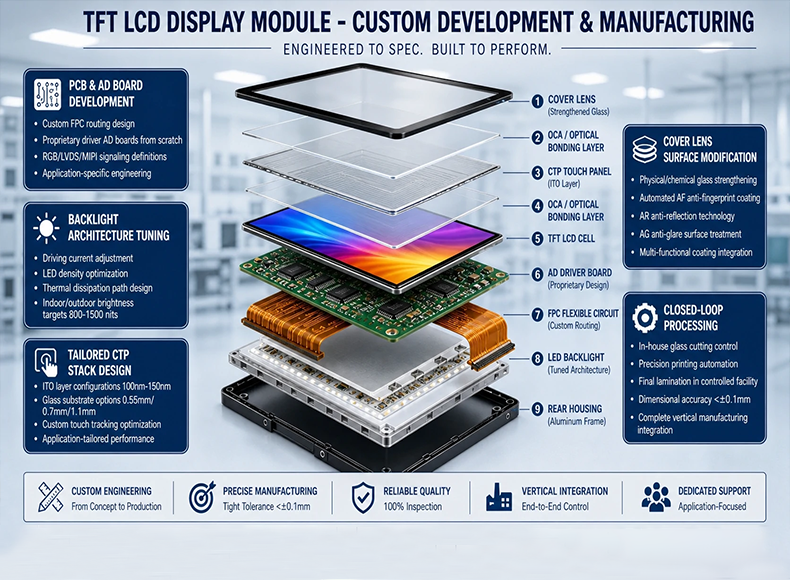
OEM Customization & Vertical Integration
- PCB & AD Board Development: Engineering custom FPC routings and proprietary driver AD boards from scratch to match specific RGB, LVDS, or MIPI signaling definitions.
- Backlight Architecture Tuning: Adjusting driving currents, LED densities, and thermal dissipation paths to meet precise indoor or high-brightness outdoor targets.
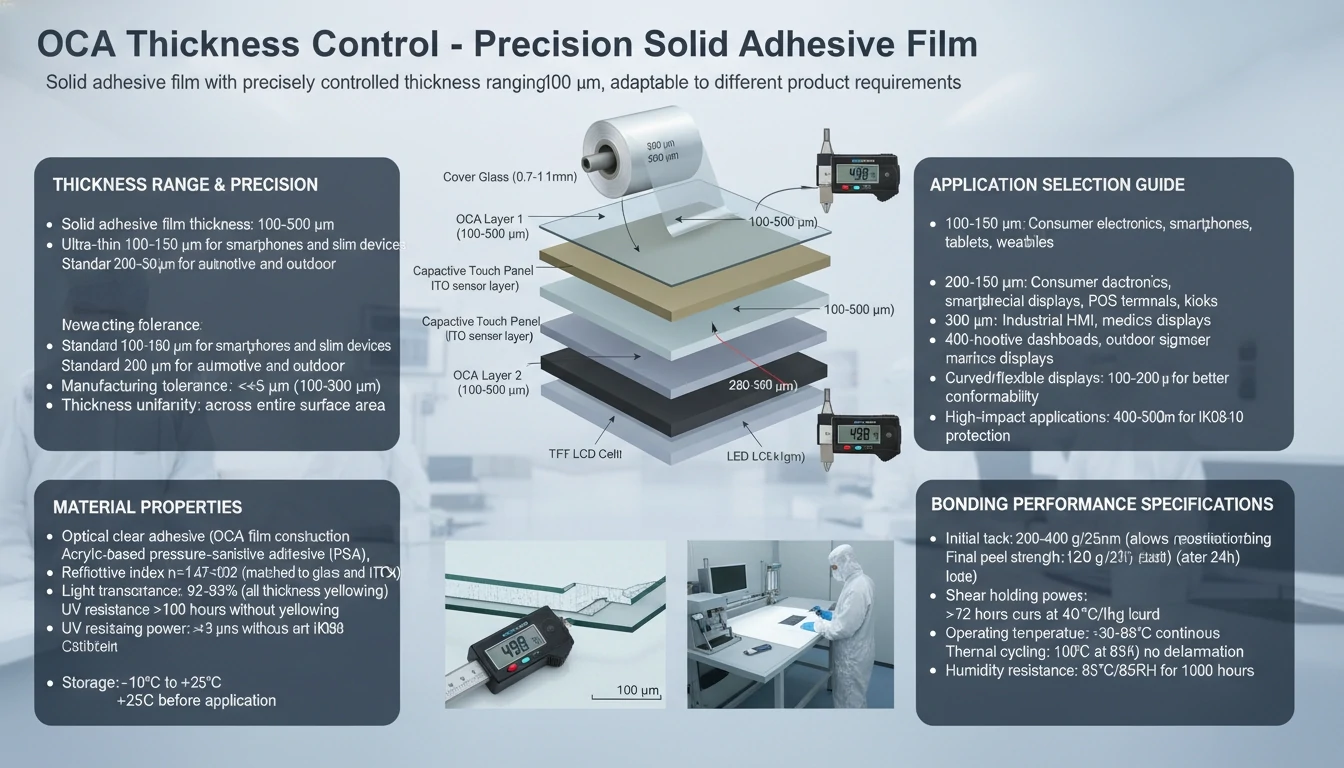
- Tailored CTP Stack Design: Modifying ITO layer configurations (100nm-150nm) and selecting appropriate glass substrates (0.55mm/0.7mm/1.1mm) for custom touch tracking.
- Cover Lens Surface Modification: Executing physical or chemical glass strengthening paired with automated anti-fingerprint (AF), anti-reflection (AR), and anti-glare (AG) coating lines.
- Closed-Loop Processing: Performing core processes—from glass cutting and printing to final lamination—within our facility to maintain strict dimensional accuracy.
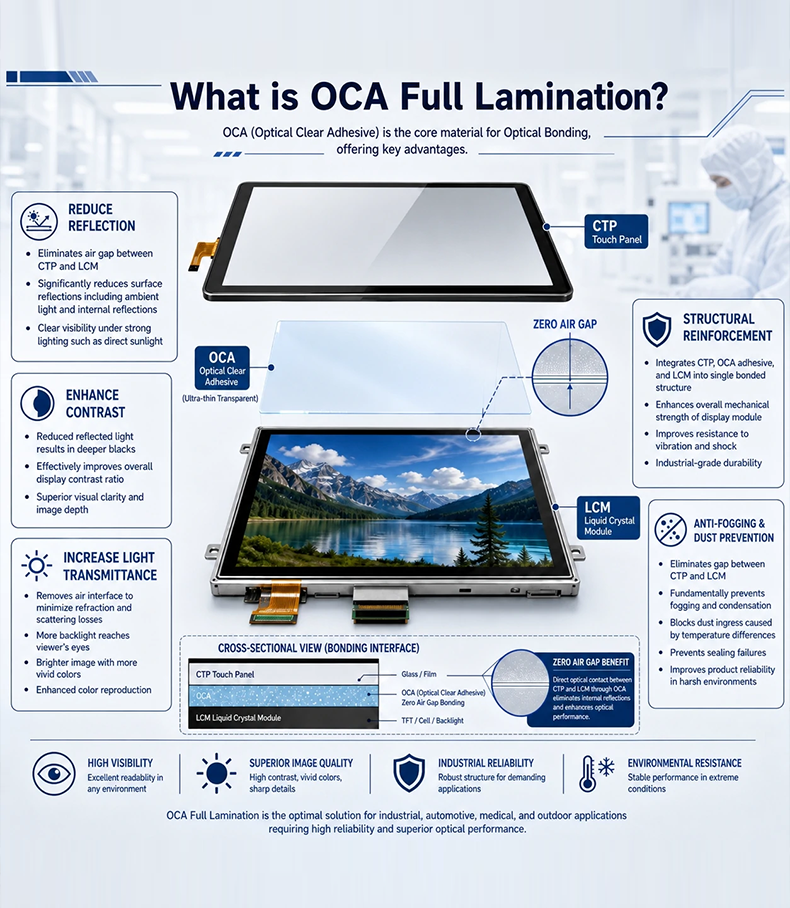
What is OCA Full Lamination?
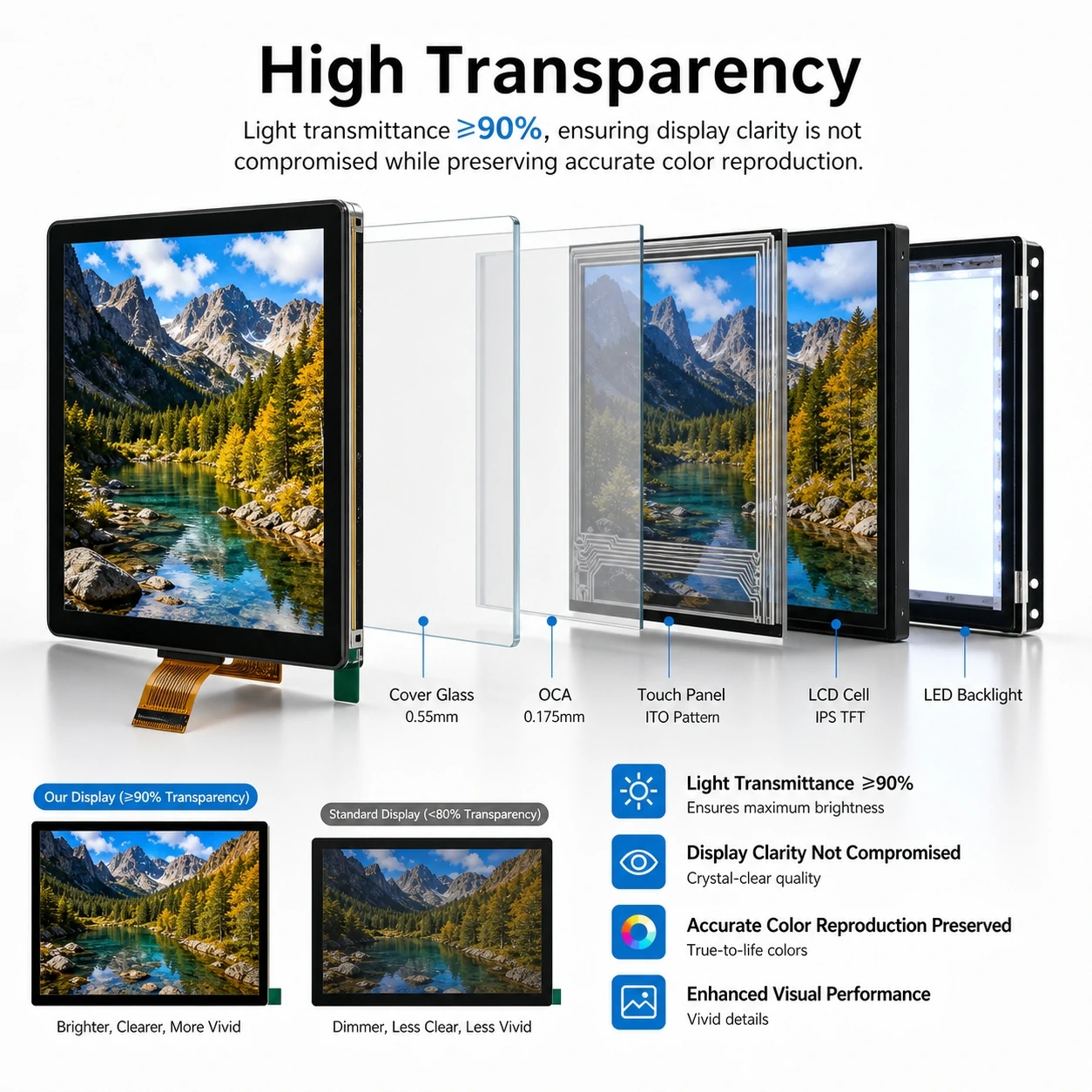
OCA (Optical Clear Adhesive) lamination is the core of our industrial TFT LCD displays. By completely eliminating the internal air gap between the touch panel (CTP) and the display (LCM), this process reduces surface reflections to ≤2%.
Reduce Reflection
Eliminates the air gap between the CTP and LCM, significantly reducing surface reflections (including ambient light reflection and internal reflections), ensuring clear visibility even under strong lighting conditions such as direct sunlight.
Enhance Contrast
Reduced reflected light results in deeper blacks, effectively improving the overall contrast of the display.
Increase Light Transmittance
By removing the air interface, refraction and scattering losses at the interface are minimized, allowing more light from the backlight to reach the viewer’s eyes, resulting in a brighter image with more vivid colors.
Structural Reinforcement
Integrates the CTP, OCA (optical adhesive), and LCM into a single structure, enhancing the overall mechanical strength of the display module and improving its resistance to vibration and shock.
Anti-Fogging and Dust Prevention
Eliminates the gap between the CTP and LCM, fundamentally preventing fogging, condensation, and dust ingress caused by temperature differences or insufficient sealing, thereby improving product reliability in harsh environments.
OCA Material Characteristics
OCA Film Pre-treatment and Lamination
Raw Material Preparation: Inspection and cleaning of the protective film, polarizer, display panel, and OCA material.
OCA Film Pre-treatment:Cleaning and pre-treatment of the OCA film in a cleanroom environment to ensure it is free of contaminants.
OCA Lamination with Glass: Precise alignment and lamination of the OCA film onto the cover lens, ensuring zero air bubbles and uniform adhesion.
Vacuum Lamination: Accurate alignment and bonding of the touch panel or display module using vacuum lamination equipment.
High-Pressure Deaeration: Removal of micro-bubbles in a high-pressure environment to ensure complete bonding without voids.
UV Curing: Comprehensive testing of optical performance, bonding strength, and visual appearance to ensure product quality meets standards.
Final Product Inspection: Evaluate optical performance, bonding strength, and appearance to ensure overall product quality.
All operations are performed in an ISO Class 5 cleanroom to minimize the impact of micro-particles on bonding quality.
Specialized tools are used to remove the OCA film’s protective layer, preventing electrostatic discharge (ESD) and fingerprint contamination.
Automated alignment and lamination equipment ensure precise positioning for a perfect fit with the OCA film.
Pressure and speed parameters are meticulously controlled to ensure uniform lamination and prevent deformation or indentations on the surface.
Special edge treatment processes are applied to prevent edge peeling issues during subsequent use.
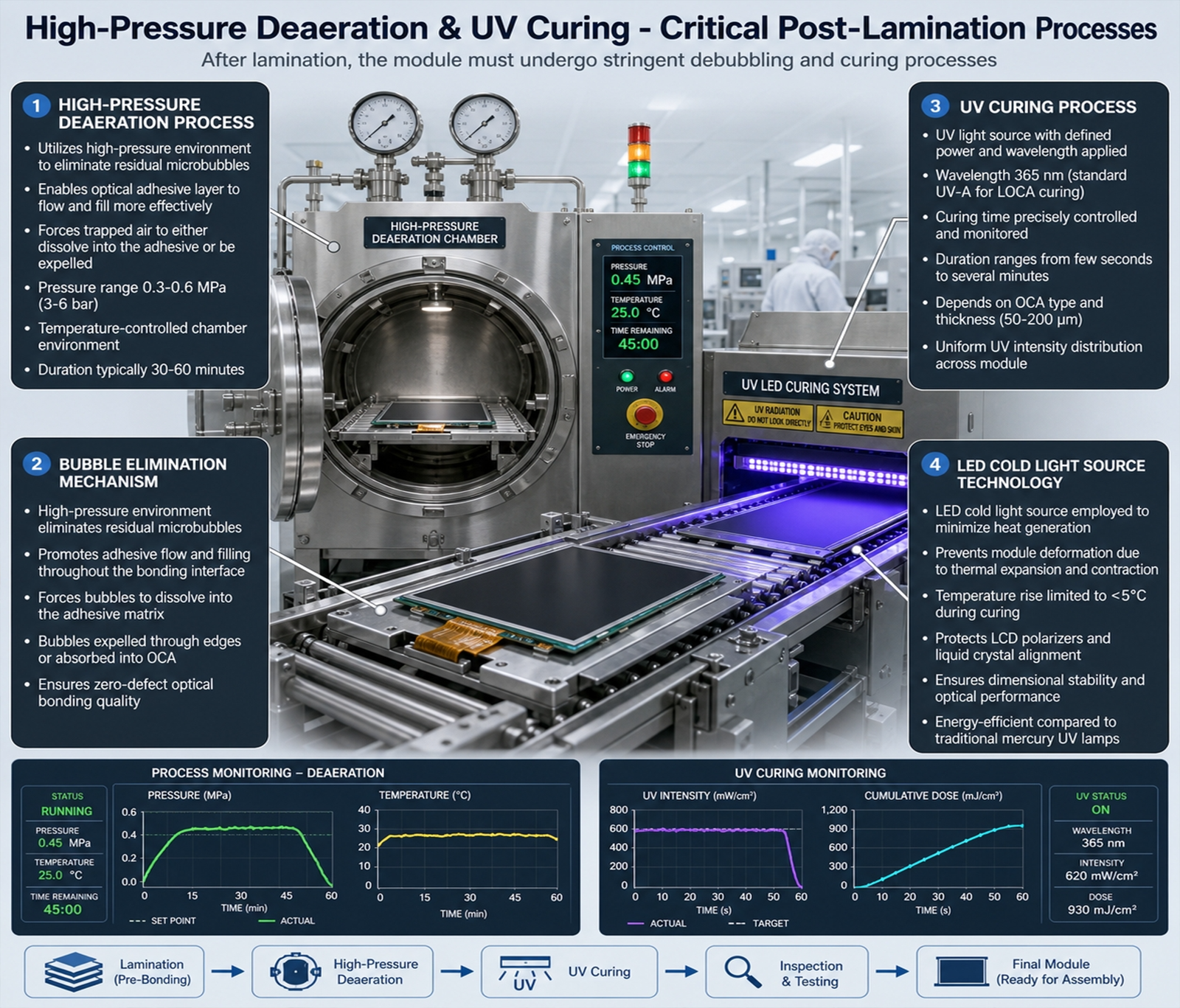
High-Pressure Deaeration and UV Curing
After lamination, the module must undergo stringent debubbling and curing processes:
Utilizes a high-pressure environment to eliminate residual microbubbles, enabling the optical adhesive layer to flow and fill more effectively, and forcing trapped air to either dissolve into the adhesive or be expelled.
The high-pressure environment eliminates residual microbubbles, promotes adhesive flow and filling, and forces bubbles to dissolve into the adhesive or be expelled.
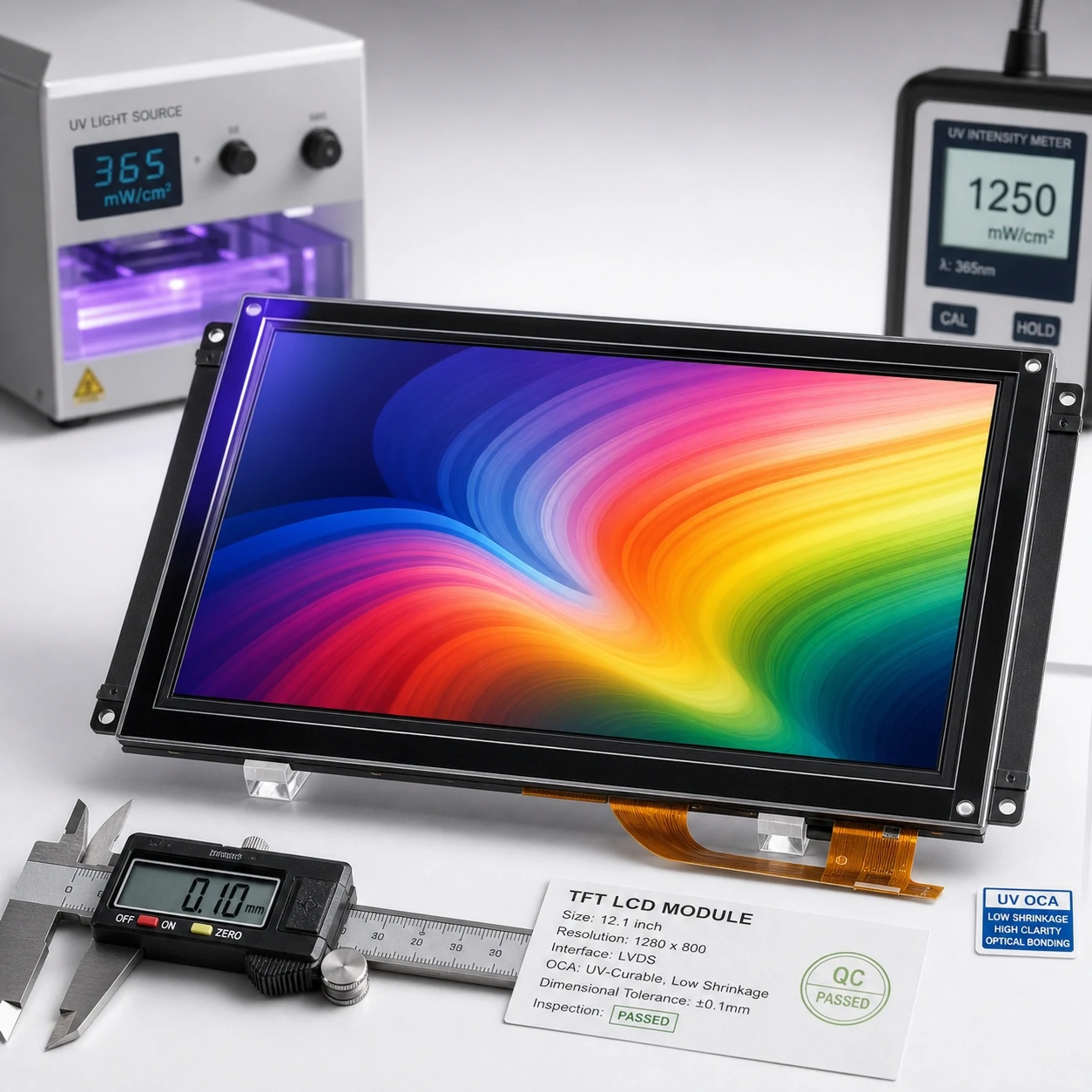
A UV light source with defined power and wavelength is applied, with curing time precisely controlled.
OCA (Optical Clear Adhesive) is the core material for Optical Bonding, offering the following key advantages:
The curing duration typically ranges from a few seconds to several minutes, depending on the type of OCA used.
An LED cold light source is employed to minimize heat generation, preventing deformation of the module due to thermal expansion and contraction.
Verified Engineering Tolerances
for Integrated TFT Modules
Our automated manufacturing cells operate within the following standardized engineering limits:
Parameter Domain | Manufacturing Limits & Production Range |
Dimensional Spectrum | Processing capacities scaling from 0.96 inch to 23.8 inch configurations |
TFT Process Control | Multi-stage ultrasonic cleaning | Automated ITO sputtering | Vacuum liquid crystal injection |
Optical Parameters | Luminance: 800 – 1500 nits | Contrast: ≥1000:1 | Transmittance: ≥90% | Reflectance: ≤2% |
CTP Sensor Layering | CTP Thickness: 1.2mm – 2.5mm | ITO Sensor Layer: 100nm – 150nm | Substrate: 0.55mm / 0.7mm / 1.1mm |
Cover Lens Armor | Thickness: 1.0mm to 6.0mm (Up to 10mm) | Hardness: ≥9H (Chemical) / ≥9.5H (Sapphire) |
Environmental Limits | Operating Range: -30°C to +85°C (Extended components up to -40°C to +105°C) |
Equipment and Environmental Requirements

Lamination Equipment
Vacuum Laminating Machine: Vacuum level ≤ -95 kPa
High-Pressure Debubbling Machine (Autoclave): Maximum pressure ≤ 0.6 MPa
UV Curing Machine: Wavelength 365 nm, adjustable power

Environmental Control
Temperature: 23 ± 2°C
Humidity: 65% ± 5% RH
Electrostatic Protection: Grounding system and ionizing air blowers

Personnel Requirements
Possess professional training and certification Strictly follow standard operating procedures (SOPs)
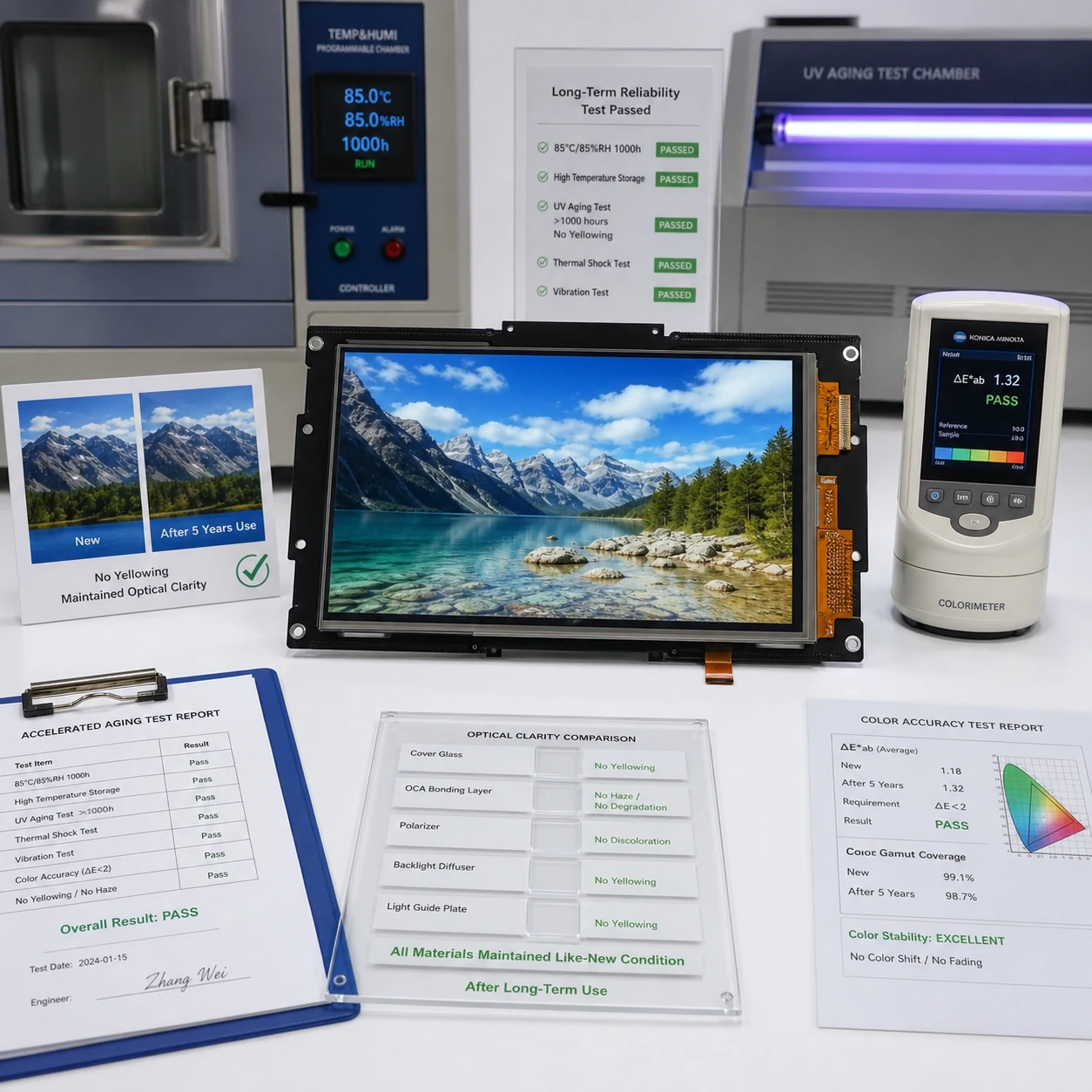
Rigorous Process Auditing & In-House Reliability Laboratory
Quality control is deeply integrated into each manufacturing block. Our dedicated on-site verification facility conducts mandatory evaluation protocols on every production run:
Ink & Adhesion Consistency
Verifying colorimetric tolerances and bonding performance of high-temperature ceramic inks via cross-hatch peel testing.
Mechanical Shock Evaluation
Performing automated physical ball-drop impacts to verify glass structural integrity from IK07 up to IK10 protection ratings.
Environmental Stress Aging
Adjusting touch controllers (Goodix, ILITEK, EETI) via high Signal-to-Noise Ratio tuning to support accurate wet-finger tracking and 19 industrial glove types.
Optical Spectral Verification
Utilizing high-precision UV spectrophotometers to confirm specific transmission baselines (90.7% standard) and haze controls (≤0.5%).

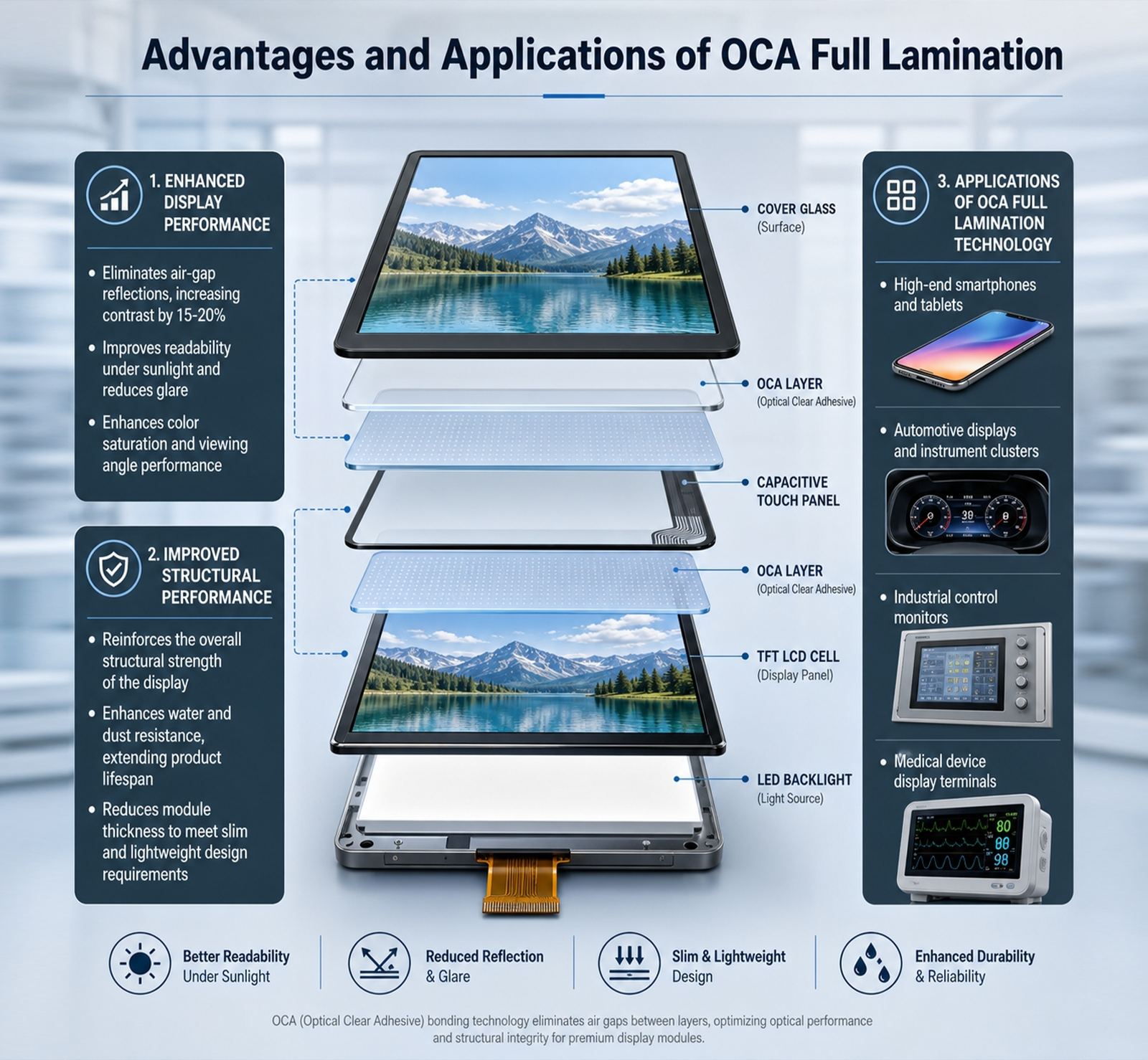
Advantages and Applications of OCA Full Lamination
Enhanced Display Performance:
● Eliminates air-gap reflections, increasing contrast by 15–20%
● Improves readability under sunlight and reduces glare
● Enhances color saturation and viewing angle performance
Improved Structural Performance:
● Reinforces the overall structural strength of the display
● Enhances water and dust resistance, extending product lifespan
● Reduces module thickness to meet slim and lightweight design requirements
Applications of OCA Full Lamination Technology:
● High-end smartphones and tablets
● Automotive displays and instrument clusters
Industrial control monitors
● Medical device display terminals
Summary and Future Trends
TFT LCD module OCA full lamination is a key process for enhancing display quality and user experience. Strict process control and environmental management ensure high yield and superior performance.
Black Semi-Transparent OCA:
Development of new black OCA materials provides deeper black levels and higher contrast.
Ultra-Thin Lamination Technology:
Further reduction of OCA thickness meets the demands of flexible displays (below 100 μm) and foldable screens (below 25 μm).
Intelligent Automated Production:
Implementation of AI-based visual inspection and robotic lamination improves yield and production efficiency.
With continuous advancements in display technology, OCA full lamination processes will keep evolving, providing reliable manufacturing support for more innovative products.


Supply Chain Security & Long-Term Availability Program
Goldconn functions as a reliable manufacturing partner for industrial OEMs by providing business and raw material stability:
- Strategic Tier-1 Partnerships: Maintaining direct allocations with leading panel manufacturers including BOE, AUO, Innolux, HannStar, IVO, and Tianma to secure structural component supply.
- High Operational Autonomy: Executing core processes internally, significantly minimizing batch-to-batch variations and unexpected logistics delays.
- 5-10 Year Longevity Framework: Providing written availability commitments backed by formal PCN (Product Change Notification) protocols and strict BOM lock policies.
- Regulatory Compliance: Manufacturing under fully audited quality management frameworks certified to ISO 9001 and IATF 16949 standards.
Manufacturing & Technical Capabilities FAQ
For custom interface conversion layouts (e.g., HDMI/VGA to LVDS/MIPI) and custom touchscreen stack-ups, our R&D team provides official engineering drawings for approval within 3 to 5 business days. Upon formal design confirmation, functional hardware prototypes are typically manufactured and dispatched within 3 to 4 weeks.
Our screen-printing cells handle customized high-temperature double-layer ceramic inks. Through precise ink formulation control, we accurately match your specified color profiles while ensuring zero peeling or degradation during long-term environmental exposure.
Our industrial supply program locks core components including the native liquid crystal glass substrate, driver ICs, touch sensor pattern design, controller chipsets, and polarizer materials. If a component EOL (End-of-Life) event occurs, we provide a formal PCN notice 6 to 12 months in advanceand secure a pin-to-pin compatible alternative.
We recognize that industrial automation, rail transit, and medical monitoring devices operate on lower-volume, highly customized profiles. Our lines feature quick-changeover tooling mechanisms specifically structured to manage low-volume mass production batches following initial prototype sign-off.
Start Your Next Generation Interconnection Solution
Contact Goldconn’s professional team of engineers today to get the best TFT LCD Display Module customization services.