High-density AI accelerators push heat flux past what rack airflow can remove. An under-specified cold plate throttles the GPU; an over-specified one wastes pump and coolant-distribution-unit (CDU) budget. This guide covers channel design, the pressure-drop trade-off, flatness and leak standards, and the data needed to quote production-ready plates.
Table of Contents
- How a Microchannel Cold Plate Works vs. a Macro-Channel Plate
- When Air Cooling Stops Working for AI Servers
- Channel Geometry and the Pressure-Drop Trade-Off
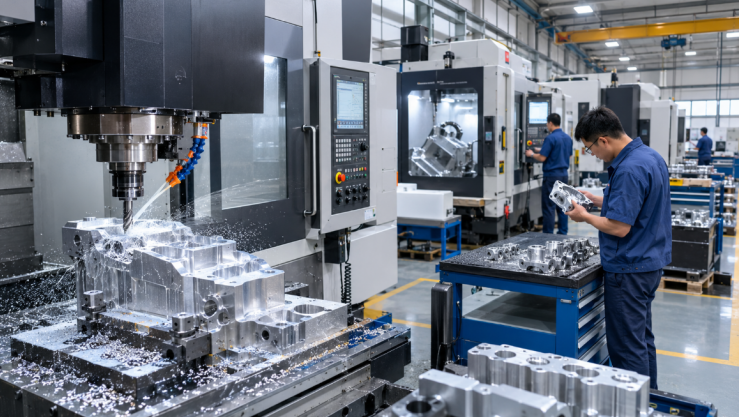
- Manufacturing, Flatness, Leak Testing, and Why the Plant Matters
- How to Evaluate a Liquid Cold Plate Supplier
- Technical Data to Send for an Accurate Quote
- Cost, Lead Time, and When NOT to Specify Microchannels
- Conclusion
1. How a Microchannel Cold Plate Works vs. a Macro-Channel Plate
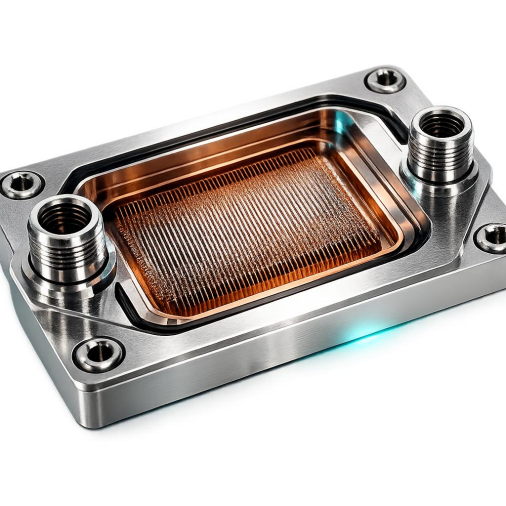
A microchannel cold plate is a direct-to-chip device that forces coolant through sub-millimeter passages above the die. Narrow channels thin the boundary layer and multiply wetted area, shortening the path from junction to fluid — the reason it beats wide-channel or tube-in-plate designs. The thermal budget splits into base conduction, spreading, contact resistance at the thermal interface material (TIM), and convection; microchannels attack spreading and convection together.
The gain carries a hydraulic cost: smaller channels raise friction and shrink clearances, so junction temperature is traded against pump head and filtration. The wider comparison sits in the custom heatsink design and manufacturing guide.
| Factor | Microchannel | Macro-channel | Use microchannel when |
|---|---|---|---|
| Internal geometry | Sub-mm fin or pin array over the die | Wide machined channels or pressed tubes | Local flux exceeds macro spreading |
| Heat transfer | High coefficient from thin boundary layer | Moderate, smaller wetted area | High-power GPU/ASIC, tight junction limit |
| Pressure drop | High; needs manifold or split-flow design | Low; plates run easily in series | Verify CDU pump head first |
| Filtration | Strict, prevents particle bridging | Tolerates larger particulates | Size strainer with channel width |
| Build method | Skiving, micro-CNC, FSW, vacuum brazing | Tube bend, epoxy, pocket mill | Match process to margin and cost |
2. When Air Cooling Stops Working for AI Servers
Air cooling fails at two points: die-level flux overwhelms spreading, or 1U/2U height and fan acoustics cap airflow. Three boundaries trigger the switch to liquid:
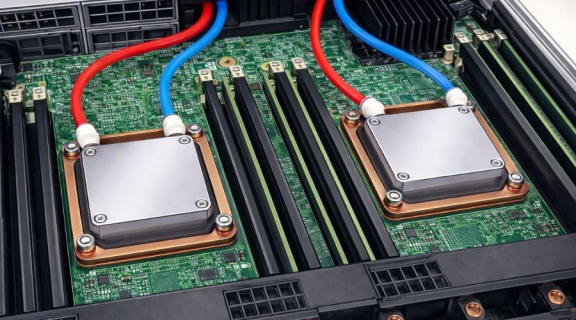
- Localized die flux: accelerators concentrate dissipation on a small die beside high-bandwidth memory (HBM), so solid bases and vapor chambers dry out before heat reaches distant fins.
- Chassis envelope: 1U/2U blades lack height for tall fin stacks, and shrinking height forces higher velocity and a steep fan-power climb.
- Downstream preheating: air over upstream sockets warms downstream voltage regulators; liquid captures heat at the source.
For moderate loads, a high-density thermal heat sink with heat pipes or a vapor chamber stays cheapest — keep air while it fits. Past that line, Goldconn’s seven in-house processes let a skived-fin air program move to liquid without changing vendors.
3. Channel Geometry and the Pressure-Drop Trade-Off
Channel geometry is a system decision, not a plate decision. More fin density lowers resistance up to a point, then friction starves flow, and the limit shifts with the rack manifold and CDU curve — a plate validated at one site is not automatically validated at another. Common internal layouts:
- Parallel straight: an inlet plenum splits across a fin bank; predictable drop, but maldistribution is a risk.
- Serpentine: one winding path resists air pockets; too long a drop for fine microchannels.
- Zigzag or wavy: disrupts the boundary layer at higher friction and machining time.
- Branched or manifolded: a top manifold feeds short banks outward, delivering the coldest fluid to the hottest zone at lower drop.
- Hybrid multi-zone: dense fins over the GPU core, wider channels over HBM and power stages on one plate.
A thermal-resistance figure without flow rate and pressure drop is meaningless. Read performance as a coupled curve — junction-to-inlet resistance against volumetric flow, plus total drop including fittings at your coolant mix and inlet temperature. Specify inlet and outlet geometry with the plate, and validate with the same fittings.
4. Manufacturing, Flatness, Leak Testing, and Why the Plant Matters
A reliable plate matches fin fabrication to joining, holds flatness at the interface, and leak-verifies every unit before shipment.
| Route | Strength | Limitation | Best for |
|---|---|---|---|
| Skived fins | Thin high-aspect fins, no joint resistance | Linear or sectioned only | Max surface over the GPU die |
| CNC micro-fin or pins | Free geometry, split manifolds | Slower on copper | Multi-die, impingement plates |
| Folded or stamped insert | High-speed, brazed in pocket | Adds a braze joint | Medium-to-high volume |
| Friction stir welding (FSW) | Solid-state bond, flat seal | Needs rigid fixtures | High-reliability plates |
| Vacuum brazing | Complex multi-layer manifolds | Anneals base; plug risk | Integrated internal fins |
Linear micro-fins use the same peeling mechanics as our skived fin heat sink process, sealed inside a fluid cavity where the fin tips meet the cover.
Flatness drives both resistance and leaks. Welding and brazing warp plates unless relieved and finish-machined; out-of-flat faces force a thicker TIM layer or uneven o-ring compression. Goldconn machines mounting surfaces to 0.01 mm per 100 mm.
Coolant choice sets corrosion risk. Deionized water performs best but needs inhibitors; water-glycol adds freeze protection at higher viscosity; dielectric fluids add safety at lower conductivity. Never mix bare copper and bare aluminum in one loop — the galvanic cell corrodes the aluminum and the debris plugs microchannels.
Leak verification is 100% per unit, not sampling. Pressure-decay catches gross weld and fitting defects; helium mass spectrometry finds sub-micron paths air sensors miss. Document method, hold time, pressure, and acceptance limit on the drawing.
The plant behind the plate: Goldconn, founded in 2004 and listed on the Beijing Stock Exchange (code 8383337), runs three plants of about 58,000 m² with 800+ staff and 300+ machines including 150 CNC units. It holds ISO 9001, ISO 14001, ISO 45001, QC 080000, IATF 16949 since 2009, RoHS and REACH, so one quality system covers an entire air-to-liquid roadmap.

5. How to Evaluate a Liquid Cold Plate Supplier
Qualify on engineering proof, not brochure claims — many vendors cite untraceable numbers or outsource welding and leak testing. Score any manufacturer, including us, on:
- 100% leak-test traceability: logs proving every unit was tested.
- In-house CFD: a sample report showing boundary conditions.
- Channel equipment: exact process and minimum production channel width.
- Flatness inspection: CMM or optical gauge tied to a drawing datum.
- Joining control: FSW or vacuum brazing in-house, with post-join cleanliness checks.
- Certifications in scope: covering thermal and mechanical work for your industry.
- First-article path: a functional prototype before hard tooling.
- Transparent quote: material, machining, joining, finishing, and testing separated.
6. Technical Data to Send for an Accurate Quote
A 3D model alone prices a machined shape, not a verified thermal solution. Send the complete loop boundary conditions:
- Heat load in watts and a die-level flux map covering the die, HBM, and voltage regulators.
- Hot-side STEP file or drawing with keep-outs, hole pattern, spring-screw load, and bolster geometry.
- Maximum pressure drop at nominal flow, plus available pump head.
- Coolant type, flow rate, inlet temperature, and filtration rating.
- Flatness tolerance and surface roughness on the interface and seals.
- Leak-test standard, working and proof pressure, and maximum leak rate.
- Envelope, fitting and mount orientation, prototype quantity, and annual volume.
7. Cost, Lead Time, and When NOT to Specify Microchannels
Microchannel plates cost more than air heatsinks or tube plates: copper raw cost, slower machining, multi-step joining with dedicated fixtures, and 100% CMM, proof-pressure and helium testing. A prototype also takes longer than a skived-fin air part, so plan it into bring-up.
Avoid microchannels when a conventional option meets budget with margin:
- Air boundary: a copper or aluminum skived-fin heatsink with heat pipes holds the junction limit within chassis height and fan acoustics.
- Macro boundary: where a liquid cold plate is still required by density, a machined macro-channel or pressed-tube design may handle the flux at lower cost and looser filtration.
- Commit to microchannels only when die flux or resistance budgets cannot be met otherwise without exceeding coolant flow.
8. Conclusion
Sourcing a microchannel plate means balancing convective area against pressure drop, holding 0.01 mm per 100 mm flatness, and enforcing 100% leak verification — treating plate, manifold, and loop as one system. Send complete thermal and hydraulic boundary conditions at RFQ to avoid throttling without over-specifying pump power or cost. Treat the first prototype as a measurement exercise: confirm the junction-to-inlet curve and pressure drop before committing to tooling.
Goldconn offers a free design-for-manufacturability (DFM) and thermal review before tooling, with a formal engineering response within two working days. To start, contact our engineering team and send your 3D STEP model plus:
- Heat load in watts and component flux map
- Coolant type, inlet temperature, and target flow rate
- Maximum allowable pressure drop across the plate
- Flatness tolerance and leak-test specification
- Prototype quantity and target delivery schedule
Frequently Asked Questions
How do I choose between air and liquid cooling for an AI server?
Judge on die flux, chassis height, and rack airflow. If a skived-fin heatsink with heat pipes meets the junction limit within fan pressure and acoustics, stay with air; when 1U/2U density throttles the GPU, move to direct-to-chip liquid.
What must a supplier receive to quote a microchannel plate accurately?
Heat load, a die-level flux map, hot-side footprint, maximum pressure drop, coolant and flow rate, inlet temperature, filtration rating, flatness tolerance, leak-test method, and prototype plus annual volumes.
How does base flatness affect performance and leak risk?
Poor flatness forces a thicker TIM layer, raising contact resistance and creating hot spots, or compresses the o-ring unevenly and leaks. Goldconn machines interfaces to 0.01 mm per 100 mm.
Which leak test should I require for data-center plates?
100% per-unit testing. Pressure-decay verifies proof pressure and gross defects; specify helium mass spectrometry for AI servers, where it finds sub-micron paths. Confirm the reject rate at design review.
How long for a custom liquid cold plate prototype?
Longer than a skived-fin air prototype, because it adds channel machining, joining, post-weld skim, and 100% testing. The schedule is confirmed in the quotation.
Are microchannel plates used beyond AI data centers?
Yes — high-power IGBT modules, EV traction inverters, RF amplifiers, medical lasers, and grid converters. Channel and joining principles carry over, but each service condition needs its own validation.