Choosing the right USB Type-C connector starts with separating three independent requirements: how much data must move, how much power must be delivered, and what mechanical and environmental loads the port will see. Get any one of these wrong and the connector becomes a field-failure point. This guide walks through each decision in the order a hardware engineer should make it, using first-hand specifications from the Goldconn USB Type-C connector range.
Table of Contents
- 1. Start With Data: Pin Count and USB Standard
- 2. Match Power Delivery to the Connector Rating
- 3. Choose Mounting Style by Mechanical Load
- 4. Seal the Connector Only If the System Is Sealed
- 5. Material and Plating Decisions
- 6. Lifecycle, Samples, and DFM Timing
- 7. Selection Checklist
- Conclusion
- Request Connector Samples
- Frequently Asked Questions
1. Start With Data: Pin Count and USB Standard
The physical USB-C shell is reversible and compact, but the internal pin configuration determines what the connector can actually do. Goldconn offers 6-pin, 16-pin, and 24-pin female receptacles. The wrong pin count turns into a board respin when the firmware team later asks for 10 Gbps data or a higher PD contract.
| Pin Count | Typical Use | Data Capability | Power Notes |
|---|---|---|---|
| 6-pin | Power-only charging, USB 2.0 | USB 2.0 (480 Mbps) | Up to 3 A typical |
| 16-pin | USB 2.0 + PD charging | USB 2.0 (480 Mbps) | PD up to 100 W / 240 W depending on contact rating |
| 24-pin | Full-featured data and power | USB 3.1 Gen 2 (10 Gbps), USB4 capable | PD up to 240 W with 5 A contacts |
For a detailed comparison of these variants and where each fits, see the USB Type-C connector comparison.
2. Match Power Delivery to the Connector Rating
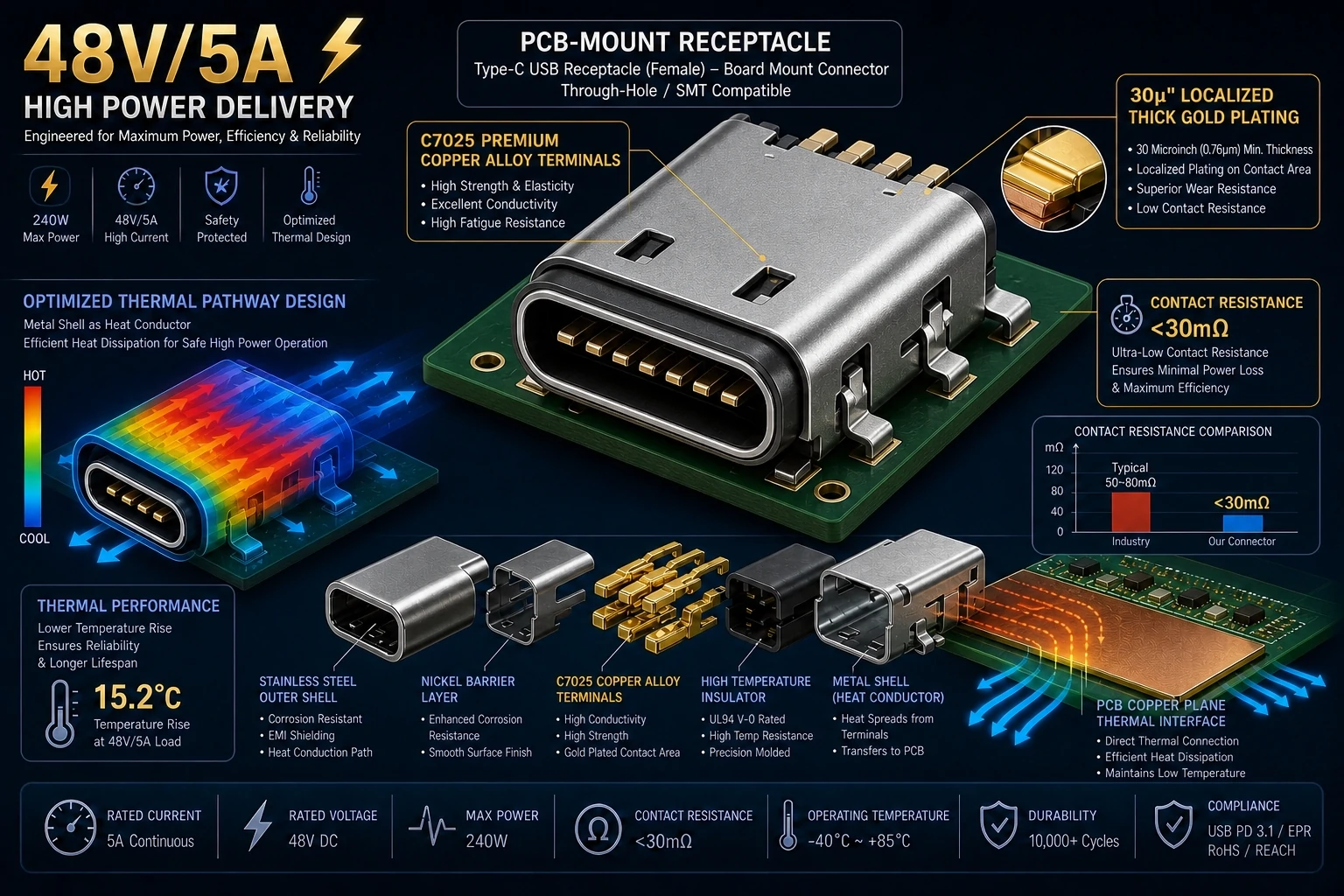
USB Power Delivery negotiates voltage and current between source and sink, but the connector hardware must survive the resulting thermal load. Goldconn’s range supports up to 240 W (48 V / 5 A), while the FAQ also references standard USB PD 3.0 at 100 W. The practical distinction is that 240 W belongs to the PD Extended Power Range profile and requires 5 A-rated contacts, thicker terminal alloy, and housing material that will not deform under thermal cycling.
Power Selection Rules
- 15–60 W consumer charging—6-pin or 16-pin with 3 A contacts is usually sufficient.
- 100 W laptops and docking stations—16-pin or 24-pin with 5 A contacts and standard PD 3.0 profile.
- 100–240 W industrial, medical, or gaming power bricks—24-pin with 5 A contacts, EPR-rated controller, and verified thermal cycling data.
3. Choose Mounting Style by Mechanical Load
The mounting style determines how insertion and cable-pull forces transfer into the PCB. Goldconn emphasizes a 6-leg THR (Through-Hole Reflow) design combined with 360° laser seamless welding, citing a 40% improvement in torque resistance and elimination of pad peeling. The choice between SMT and THR is therefore not about convenience; it is about field reliability.
| Mounting Style | Best For | Limitations |
|---|---|---|
| SMT | Thin consumer devices, minimal cable stress | Higher pad-peeling risk under torque and vibration |
| THR | Industrial, automotive, medical, frequent insertion | Requires board thickness and reflow process control |
| Mid-mount | Very low-profile designs | Reduced mechanical anchoring; verify retention carefully |
4. Seal the Connector Only If the System Is Sealed
Goldconn offers IPX4 splashproof and IPX8 submersible Type-C connectors with LSR internal sealing and perimeter gaskets. A sealed connector is valuable only when the full mating system—plug, cable gland, and enclosure—is also sealed. Specifying IPX8 on a port that vents into an unsealed housing wastes cost and creates a false sense of security.
When to Specify Each Rating
- IPX0/IPX2 (no sealing)—indoor consumer electronics with no liquid exposure.
- IPX4—occasional splash, kitchen appliances, light outdoor use.
- IPX8—washdown equipment, marine, outdoor infrastructure, medical devices exposed to cleaning fluids.
5. Material and Plating Decisions
Material choices directly affect contact resistance, wear, and reflow stability. Goldconn specifies C7025 high-conductivity copper alloy terminals with 30 µ” localized gold plating over nickel. The stainless-steel shell provides EMI shielding and mechanical stiffness, while the LCP housing survives high-reflow temperatures. Buyers should request the specific plating thickness and housing material grade in the BOM because a thinner gold layer or lower-grade alloy will degrade under high-cycle or high-humidity conditions.
6. Lifecycle, Samples, and DFM Timing
For industrial, medical, and automotive programs, the connector must remain available for the product’s full life. Goldconn offers a minimum 8-year longevity program and provides up to 100 free samples for validation. The recommended sequence is to request samples for coplanarity and insertion-force checks, run them through your reflow profile and environmental tests, then lock the BOM before mass production. This prevents late-stage swaps that invalidate tooling and certification.
7. Selection Checklist
- Confirm required data rate and map it to pin count (6/16/24).
- Confirm PD profile—standard PD 3.0 (100 W max) or EPR (up to 240 W).
- Confirm current rating (3 A vs 5 A) at the selected power level.
- Select mounting style based on insertion frequency, vibration, and cable-pull loads.
- Define waterproof grade only after enclosure and cable sealing are known.
- Request material and plating specifications in writing.
- Validate samples through reflow, thermal cycling, insertion life, and salt spray.
- Confirm supplier longevity program, PCN policy, and traceability.
Conclusion
A USB Type-C connector should be chosen by data requirement first, power requirement second, and mechanical/environmental load third. Pin count and USB standard determine whether the connector can support the advertised data rate; current rating and contact alloy determine whether it can survive the thermal load; mounting style and sealing determine whether it survives the physical world. For the broader supplier and manufacturing picture, read the main USB Type-C connector selection and procurement guide.
Request Connector Samples
Send us your data rate, power budget, mounting constraints, waterproof grade, and target annual volume. Our engineering team will recommend a 6-pin, 16-pin, or 24-pin configuration and ship up to 100 free samples for your reflow and reliability testing, together with a project quotation.
Frequently Asked Questions
How do I know if I need a 24-pin Type-C connector?
You need 24 pins when your product uses SuperSpeed data lanes (USB 3.1 Gen 2 at 10 Gbps, or USB4) or when you want a future-proof port that can support both high-speed data and high-power delivery.
What current rating do I need for 240 W?
240 W at 48 V requires 5 A continuous current. Both the connector terminals and the cable assembly must be rated for 5 A; a 3 A system cannot safely deliver 240 W.
When should I choose THR over SMT?
Choose THR when the connector will see frequent insertion, vibration, cable-pull stress, or outdoor temperature swings. SMT is acceptable for low-stress consumer electronics where board height is critical.
Does IPX8 guarantee my device is waterproof?
No. IPX8 only certifies the connector under specified immersion conditions. The full device is waterproof only if the enclosure, cable entry, plug seal, and gasket design are all validated as a system.
Why does localized gold plating matter?
Localized gold plating places the precious metal only on the contact mating surface, reducing cost while preserving low contact resistance and corrosion resistance. A specified 30 µ” thickness balances durability against mating-cycle wear.
How many free samples are available?
Goldconn provides up to 100 free male or female Type-C connector samples packaged in tape-and-reel format for engineering validation and DFM review.
What is a typical DFM review timeline?
After receiving requirements, the company typically provides quality assurance information and certification materials within 24 hours, followed by engineering drawings and a quotation for sample and mass production.