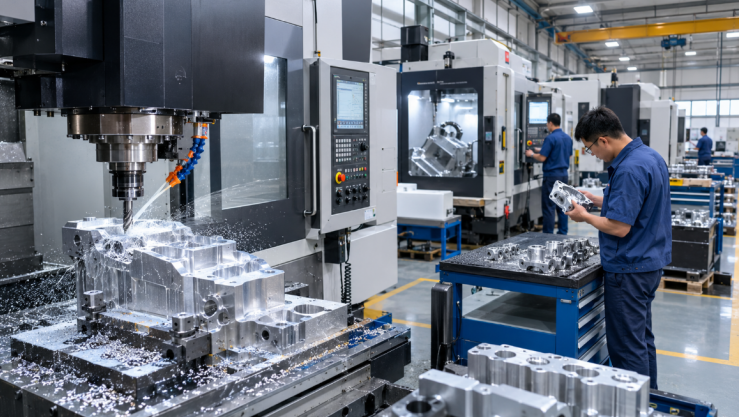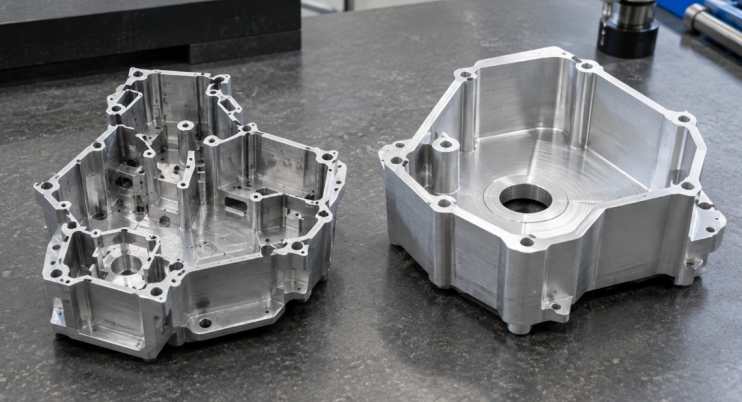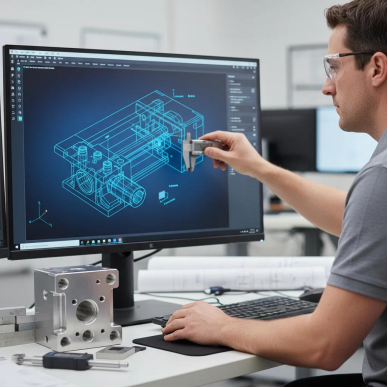
Sheet metal fabrication and hard stamping both turn flat sheet metal into finished parts, but they sit at different points on the cost, volume and flexibility curve. Fabrication cuts and bends with little or no hard tooling and suits low-to-mid volume and designs that keep changing. Hard stamping feeds strip through a progressive die and suits high-volume, stable designs where every part must be near-identical. This guide goes past the basics: it covers the DFM rules that actually decide which process fits, what the tolerances mean in practice, where stamping overtakes fabrication on cost, and a decision path you can apply to a real drawing.
- 1. What This Comparison Covers
- 2. What Is Sheet Metal Fabrication?
- 3. What Is Hard Stamping?
- 4. Sheet Metal Fabrication vs Hard Stamping: Side-by-Side
- 5. DFM Constraints: Why the Two Processes Differ in Design
- 6. Tolerances and GD&T: Reading the Numbers
- 7. When to Choose Sheet Metal Fabrication
- 8. When to Choose Hard Stamping
- 9. Cost Structure and Where Stamping Overtakes Fabrication
- 10. Can You Combine Both in One Product?
- 11. A Decision Tree: How to Pick the Right Process
- 12. Industry Examples: How Real Parts Get Sorted
- 13. Materials and Tolerances
- 14. How Goldconn Runs Both Under One Roof
1. What This Comparison Covers
Sheet metal fabrication and hard stamping sit next to each other in the metal manufacturing family: both start from flat stock and produce thin-wall parts such as brackets, enclosures, shields and clips. The difference is how they shape the metal. Fabrication is a flexible, low-tooling path built on cutting, bending and joining. Hard stamping is a high-output path built on a dedicated progressive die.
In this article you will see what each process does, a side-by-side comparison, the DFM rules that separate them, what the tolerances mean for your drawing, the cost logic that drives the choice, a step-by-step decision path, and how real parts in EV, medical and industrial control programs get sorted between the two.
2. What Is Sheet Metal Fabrication?
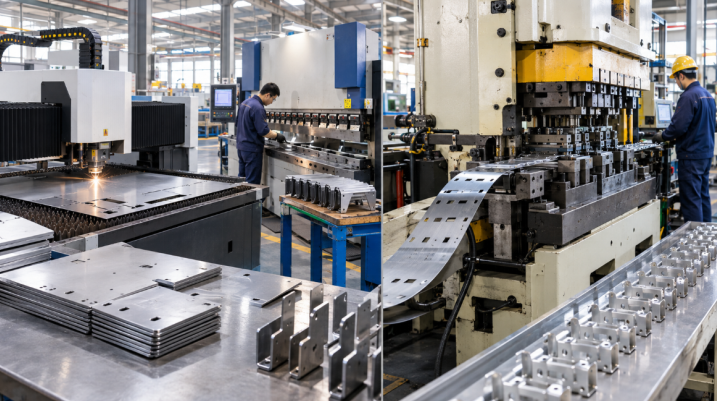
Sheet metal fabrication is a flexible way to turn a flat sheet into a finished part. It usually starts by cutting the sheet, at Goldconn this is done on fiber laser cutting lines, then forms the blank by press braking, and joins pieces by welding or mechanical assembly. A single part can move from a flat blank to a finished enclosure without any hard production die.
Goldconn’s sheet metal and laser service handles material from 0.1 mm to 10 mm thick and pairs cutting with bending, welding, surface treatment and inspection in one flow. In-process and final checks use CMM and optical measurement so dimensions stay verified, not assumed. See how our sheet metal and laser cutting service works.
Because there is no progressive die to wait for, simple parts can go from drawing to first sample in days. That makes fabrication the natural choice for prototypes, low-volume runs and designs that are still changing.
3. What Is Hard Stamping?
Hard stamping, also called precision stamping, shapes sheet by feeding strip stock through a progressive die in a press. Each press stroke cuts and forms the part a little more, and the finished part drops out after the last station. The die is the heart of the process, and its quality sets the quality of every part.
Goldconn builds the progressive tooling in-house and typically needs 4 to 8 weeks from tooling start to first article, with confirmed tolerances around ±0.05 mm on critical features. Explore our hard stamping capabilities.
Once the die is made, every part is near-identical and the per-part cost falls as volume rises. Stamping is the right answer for stable, high-run parts such as terminals, contacts, shields and clips.
4. Sheet Metal Fabrication vs Hard Stamping: Side-by-Side
| Aspect | Sheet Metal Fabrication | Hard Stamping |
|---|---|---|
| How it shapes the part | Laser or plasma cut, then bent, welded and assembled | Strip fed through a progressive die; cuts and forms in press strokes |
| Tooling needed | Minimal; fixtures and NC programs only, no hard die for cut and bend | Dedicated progressive die required |
| Upfront lead time | Days to first part for simple parts | 4 to 8 weeks for die plus first article |
| Best production volume | Low to mid volume; frequent design changes | High volume; stable design |
| Typical tolerance (Goldconn) | ±0.1 mm typical, tighter on request | ±0.05 mm typical, tighter on critical features |
| Design flexibility | High; revisions are low cost | Low; a die change is costly |
| Per-part cost trend | Higher at very high volume | Lower at high volume |
| Typical parts | Enclosures, brackets, frames, prototypes | Terminals, contacts, shields, high-run clips |
The short version: fabrication wins on flexibility and speed to first part; stamping wins on repeatability and unit cost at scale. The sections below show the engineering reasons behind that split.
5. DFM Constraints: Why the Two Processes Differ in Design
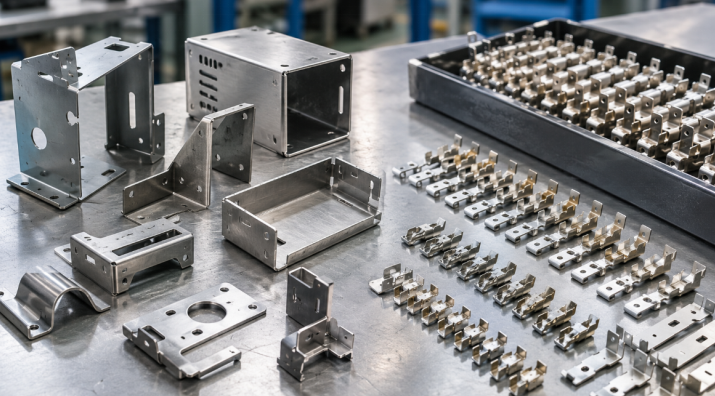
Design for manufacturability is where the two processes really diverge. The same drawing can be easy to fabricate and hard to stamp, or vice versa, depending on a handful of rules. Knowing them early stops you from designing a part that only fits one process at a painful cost.
| Design rule | Sheet Metal Fabrication | Hard Stamping |
|---|---|---|
| Minimum bend radius | Tied to material thickness and temper; a tight radius cracks or distorts the bend, so keep the radius generous | Radius is set by the tool and can be tight, but drawn features need wall taper to release |
| Feature near a bend | Keep holes and slots clear of the bend line so they do not distort when the flange forms | Pierce the hole in the flat strip before the forming station; station order controls the result |
| Springback / form rebound | Bends spring back slightly; the program over-bends to hit the angle | The die controls the form; rebound is minimal when the tool is correct |
| Wall taper (draft) | Not needed; the part is bent, not drawn | Required on drawn features so the part strips cleanly from the die |
| Material utilization | Nesting yield on the sheet; off-cuts can often be used | Scrap bridge between parts on the strip is process loss |
| Cost of a design change | Edit the cut nest or bend program; low cost | Modify or rebuild the die; high cost |
| Joining | Welding, fasteners and PEM inserts are common and easy to add | Usually one piece out of the die; welding is added only when needed |
Practical takeaway: if your part changes often, or needs welded assemblies and inserts, fabrication absorbs the change cheaply. If your part is stable and you can live with die-driven constraints like draft and station order, stamping pays you back in repeatability. For the stamping-vs-laser angle of the same family, our metal stamping vs laser cutting guide covers where each cutting method fits.
6. Tolerances and GD&T: Reading the Numbers
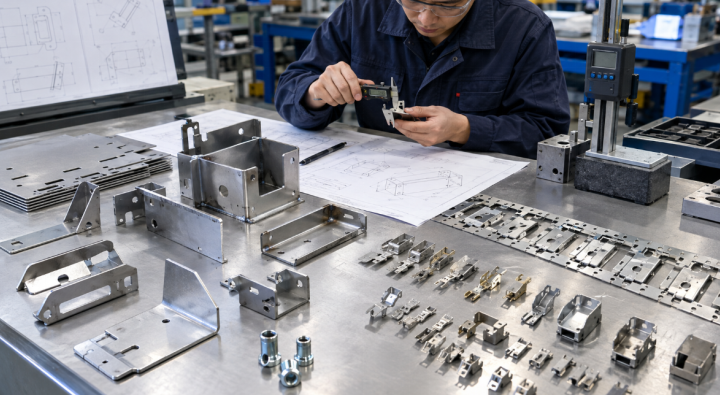
A tolerance block that says ±0.1 mm or ±0.05 mm hides a question: which feature, and against what? The two processes behave differently once you look past a single dimension.
| Tolerance aspect | Fabrication (typical) | Stamping (typical) |
|---|---|---|
| Cut feature size | ±0.1 mm typical | ±0.05 mm typical |
| Formed or bent feature | Bending adds small variation; hold the callout looser or call it out separately | The die sets the form, so it repeats well part to part |
| Feature-to-feature across the part | Depends on fixturing and how many assembly steps you add | Very consistent from the same die, run after run |
| Hole-to-edge / hole-to-hole | Good with laser; watch the heat-affected edge | Excellent; holes are pierced in a station |
| When to use GD&T | For datums and true position across an assembly | For true position and repeatability at volume |
| Edge quality | Laser edge may need deburring; a small heat-affected zone is present | Sheared edge shows burnish and break; burr side is fixed by the die |
Two rules of thumb: first, a stamped part holds feature-to-feature repeatability far better than a fabricated one, because every part shares one die rather than several setups. Second, if your function depends on true position between features across an assembly, call out GD&T datums instead of stacking simple ± dims, whichever process you pick.
7. When to Choose Sheet Metal Fabrication
- Your design is still changing and you expect revisions.
- Your volume is low to mid, or you need many variants of one part.
- You need first parts in days, not weeks.
- The part needs complex 3D forms created by bending and welding.
- You have no budget or time for a hard production die.
Fabrication is also the default for new-product introduction, where the drawing moves faster than the volume justifies a die. For the full map of processes in one place, our metal manufacturing services overview walks through fabrication, stamping, machining and casting side by side.
8. When to Choose Hard Stamping
- Your design is stable and will not change for a long run.
- Your volume is high enough to spread the die cost across many parts.
- You need tight, repeatable tolerances on every part.
- The part is simple enough to form in a progressive die.
- Lowest possible per-part cost is a priority.
Stamping rewards stability. The moment you expect a form change, the die cost comes back to haunt you, so only commit to stamping when the drawing is frozen.
9. Cost Structure and Where Stamping Overtakes Fabrication
The right way to compare cost is total cost across the program, not the unit price on a quote. The two processes carry cost in opposite places.
| Cost factor | Fabrication | Stamping |
|---|---|---|
| Upfront (tooling) | Fixtures and NC programs; low | Progressive die; high, plus 4 to 8 weeks |
| Per-part at low volume | Lower, because there is nothing to amortize | Higher, because the die cost spreads over few parts |
| Per-part at high volume | Rises with labor and setup per part | Drops steeply as the die cost is absorbed |
| Design change | Cheap (program edit) | Expensive (die work) |
| Secondary operations | Weld, tap and finish add separate steps | Pierce, form and trim happen in-die; fewer separate ops |
| Material use | Nesting yield; off-cuts reusable | Strip scrap bridge is process loss |
The crossover sits where the stamping die cost, spread across enough parts, drops below the steady per-part labor of fabrication. That point moves with part complexity, how stable the design is, and how much secondary work each path needs, so a DFM review beats a rule of thumb. The decision tree below turns this into a yes-or-no path.
10. Can You Combine Both in One Product?
Yes, and it is common. A typical approach is to stamp the high-volume base part for low unit cost, then use fabrication for low-volume brackets or late-stage variations that do not justify a die. Some projects stamp a raw blank and then fabricate it further. Running both under one roof keeps tooling, quality and logistics in one hand.
11. A Decision Tree: How to Pick the Right Process
Use this path on a real drawing. Answer top to bottom and stop at the first fit.
- Is the design frozen for a long production run? If no, choose fabrication. If yes, continue.
- Is annual volume high enough to amortize a progressive die? If no, choose fabrication. If yes, continue.
- Do you need tight, repeatable tolerances across thousands of identical parts? If yes, choose stamping. If the part needs complex 3D forms or welded assemblies, choose fabrication or a hybrid.
- If volume is high but the form is too complex for one die, choose a hybrid: stamp the base, fabricate the rest.
This tree is why the two processes are not competitors but neighbors on the same curve: fabrication owns the left (changing, low volume), stamping owns the right (stable, high volume), and the hybrid owns the awkward middle.
12. Industry Examples: How Real Parts Get Sorted
| Part type | Common pick | Why |
|---|---|---|
| EV charge enclosure | Fabrication | Low-to-mid volume, frequent revisions, complex bent forms |
| High-run EV bracket | Stamping | Stable design, high volume, tight repeatability |
| Medical chassis | Fabrication | Low volume, strict revisions, complex assemblies |
| Industrial control shield | Stamping | Thin, stable, high volume |
| Connector terminal or contact | Stamping | Very high volume, tight true position |
| Prototype / NPI part | Fabrication | Speed to first part while the drawing moves |
These are starting points, not rules. A medical part that stabilizes at high volume can move to stamping; an EV bracket that keeps revising can stay in fabrication. The drawing and the forecast decide, which is exactly what a DFM review is for.
13. Materials and Tolerances
| Process | Common materials | Thickness / notes |
|---|---|---|
| Sheet metal fabrication | Stainless steel, carbon steel, aluminum, copper, brass | 0.1 mm to 10 mm sheet; formed by bending and welding |
| Hard stamping | Stainless 304 and 316, carbon steel, spring steel, galvanized steel, aluminum, copper, brass | Strip stock; ±0.05 mm typical on critical features |
Both processes draw from the same family of sheet metals, so material choice rarely decides between them. Volume, stability and tolerance repeatability do. For finished components that combine several processes, see our custom metal components page.
14. How Goldconn Runs Both Under One Roof
Goldconn runs three production bases of about 58,000 square meters with 300-plus machines and 800-plus staff, and has built metal parts since 2004. The company is listed on the Beijing Stock Exchange, code 8383337, and is a national high-tech enterprise, with ISO 9001, ISO 14001, ISO 45001, QC 080000 and IATF 16949 certifications and RoHS compliance.
Because fabrication, stamping, machining and casting share one floor, a single DFM review can weigh all of them against your part, including the hybrid path. Goldconn returns a quote within 24 hours of a clear inquiry, so you compare processes with real numbers instead of guesses. Start a process comparison with our metal manufacturing team.
Frequently Asked Questions
Is sheet metal fabrication stronger than hard stamping? Strength depends on material and design, not the process. Both can use the same alloys; the choice is about volume and form, not strength.
Which is cheaper for 500 parts? Usually fabrication, because there is no die to pay for. Stamping only pulls ahead once volume is high enough to spread the tooling cost.
Can hard stamping hold tighter tolerances than fabrication? Yes, stamping typically holds about ±0.05 mm on critical features at Goldconn, versus about ±0.1 mm typical for fabricated parts, with tighter values possible on request for both.
How long does stamping tooling take? At Goldconn the typical path from tooling start to first article is 4 to 8 weeks. Fabrication can often deliver first samples in days.
Can Goldconn run both processes for one project? Yes. Many programs stamp the high-volume base and fabricate low-volume variants, all under one roof.
What materials can be stamped? Stainless 304 and 316, carbon steel, spring steel, galvanized steel, aluminum, copper and brass, among common strip stocks.
Do you help with design before I choose a process? Yes. Goldconn offers a free DFM review that weighs fabrication, stamping, machining and casting against your part.
How do I get a quote? Send your drawing and expected volume. A quote is normally returned within 24 hours.
Request a Free DFM Review
Not sure whether sheet metal fabrication or hard stamping fits your part? Send your drawing and target volume and Goldconn will review the design for manufacturability, recommend the right process, and return a quote within 24 hours. Start your DFM review with our metal manufacturing team.