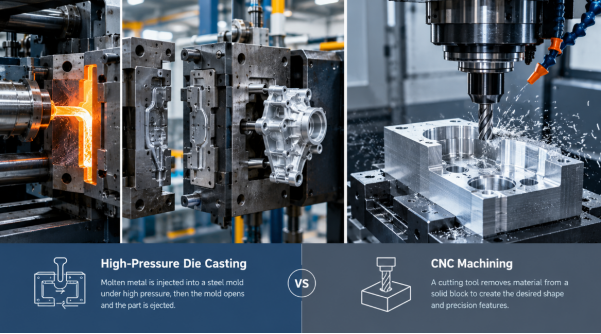
Die casting and CNC machining both make solid metal parts, but they reach the same shape by opposite routes. Die casting pours molten metal into a steel die; CNC cuts the part out of a solid block. That difference decides cost, lead time, and which tolerances you can hold, so the choice is mostly about volume and geometry. This article shows where the two cross over and gives you a way to pick based on factors that matter.
Table of Contents
- 1. How the Two Processes Build a Part
- 2. The Cost Trade: Tooling vs Machine Time
- 3. Tolerances and What They Cost
- 4. Lead Time: Tooling vs No Tooling
- 5. Materials Each Process Can Run
- 6. Geometry Rules You Must Respect
- 7. A Pick-by-Factors Framework
1. How the Two Processes Build a Part
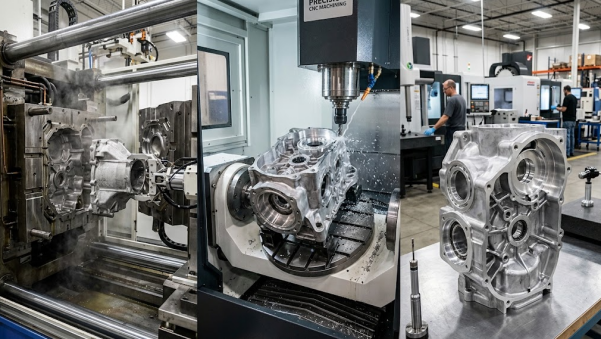
Die casting forces molten aluminum, zinc, or magnesium into a hardened steel die at high pressure. The metal solidifies in seconds, the die opens, and the part drops out near its final shape. You can read the full process and alloy list on our die casting page. Because the shape lives in the tool, every shot after the first is nearly free to make. Goldconn designs and builds its die casting molds in-house, which keeps direct control over die quality, cost, and lead time.
CNC machining starts from a solid block and removes everything that is not the part. There is no tool to pay for, but every part spends machine time. That trade, tooling cost versus cycle time, is the whole story.
2. The Cost Trade: Tooling vs Machine Time
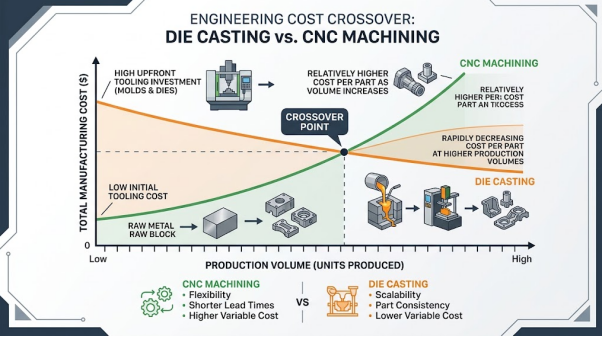
A die casting tool is a real investment that you recover only by spreading it across many parts. Below low volume, CNC is usually cheaper because there is no tool to amortize. Above that range the math flips, because a die casting cycle is seconds while a CNC cycle is minutes. The exact crossover depends on part size and cycle time, so the only safe answer is to quote both processes at your real volume before you commit.
The table shows the pattern in plain terms rather than fixed numbers, because the crossover moves with the part.
| Volume | Die casting | CNC machining |
| Low volume | Tool cost dominates | Cheapest, no tooling |
| Mid volume | Tool still weighs on unit cost | Often competitive |
| High volume | Tool paid back, low per-part cost | Cycle time adds up |
| Very high volume | Far cheaper per unit | Too slow and costly |
Goldconn offers a free DFM review and a 24-hour quote, so you can price both routes on your actual drawing instead of guessing at a crossover.
3. Tolerances and What They Cost
Die casting at Goldconn typically holds plus or minus 0.05 mm, and tighter on critical features, with the exact value depending on part geometry, material, and size. The as-cast surface is good enough for many uses, but threads, tight bores, and sealing seats are almost always CNC machined after casting. That post-machining step is where die cast parts actually hit the tightest numbers.
CNC holds plus or minus 0.01 mm on critical features as a matter of course, with no extra operation. If your part needs a true-position callout under the die cast range or a precision thread straight from the process, CNC wins without argument. Die casting only competes after you add machining, which eats into its cost edge.
4. Lead Time: Tooling vs No Tooling
This is the part teams underestimate. A CNC first article can ship in days because there is no tool. Die casting needs the steel die built and proved, which at Goldconn typically runs four to eight weeks for tooling design and the initial sample (FAI) before the first good part exists. If your program is late, that gap can decide the process on its own.
A common path is to CNC the prototype and pre-production parts, then move to die casting once the design is frozen and volume is confirmed. That needs a supplier who does both, which our CNC machining service guide covers when you scope prototype-to-production.
5. Materials Each Process Can Run
Die casting is limited to metals that flow when molten and survive the die: aluminum (A380, ADC12, A360), zinc (ZAMAK 3, 5, 7, 8), and magnesium (AZ91D) are the workhorses. You get good strength-to-weight and thin walls, but not every alloy casts cleanly.
CNC machines nearly any solid stock: the castable alloys plus titanium, copper, brass, hardened steel, and most plastics. If your part needs a material that does not cast, or a plastic insert in the same operation, machining is the only route. The table lists the practical split.
| Material | Die cast | CNC |
| Aluminum (A380 / ADC12 / A360) | Yes | Yes |
| Zinc (ZAMAK 3 / 5 / 7 / 8) | Yes | Yes |
| Magnesium (AZ91D) | Yes | Yes |
| Titanium | No | Yes |
| Copper, brass | No | Yes |
| Hardened steel | No | Yes |
| Plastics | No | Yes |
6. Geometry Rules You Must Respect
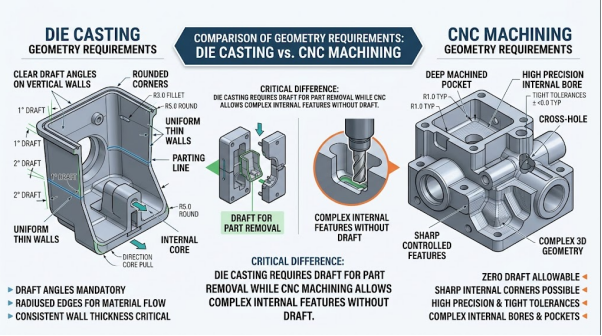
Die casting demands draft angle on every surface that pulls out of the die, and thin walls need careful design so the molten metal fills cleanly. Internal threads and very tight bores are cored or machined after, not cast. Goldconn handles these rules in its DFM consultation, so the design is reviewed before tooling is cut.
CNC has none of those rules. Internal pockets, cross-holes, and complex three-dimensional shapes are its strength. The limit is cost: deep pockets and thin walls simply take more machine time. A one-stop shop that offers both, like the scope on our Metal Manufacturing Services page, can cast the body and machine the seats in one flow.
7. A Pick-by-Factors Framework
Run the part through these checks in order. The first firm answer usually decides it.
- Design not frozen, or lead time under a few weeks? Lean CNC for now.
When the answers split, prototype in CNC and plan the die for production. A DFM review before tooling spends the money confirms the split and catches thin walls or zero-draft faces that would ruin the cast.
Frequently Asked Questions
What volume makes die casting worth the tool?
It depends on part size and cycle time, so there is no single fixed number. Below low volume CNC is usually cheaper because there is no tool; as volume climbs the tool pays back and die casting wins on unit cost. Quote both processes at your real volume to find the line for your part.
Can die casting hold CNC-class tolerances?
Only with post-machining. The as-cast part holds about plus or minus 0.05 mm and tighter on critical features; threads, bores, and sealing faces are cut after casting to hit the tightest numbers. If you need precision straight from the process, CNC is the answer.
Why does die casting take so long to start?
The steel die has to be designed, cut, heat-treated, and proved, which at Goldconn runs about four to eight weeks before the first good part exists. CNC skips that because the program and fixtures are quick. Late programs often pick CNC just to save the clock.
Which metals cannot be die cast?
Titanium, copper, brass, hardened steel, and plastics do not suit high-pressure die casting. They either will not flow cleanly or damage the die. All of them machine readily, so CNC covers the materials casting cannot.
What happens if my part has no draft angle?
The die cannot release the part, so the tool needs side actions or the design must change. Both add cost. A DFM review flags zero-draft faces early so you can add a degree or two rather than pay for a sliding core.
Should I prototype in CNC then die cast?
Often yes. CNC proves the design in days and covers pre-production while the die is built. When volume confirms, the same CAD feeds the die with only the draft and wall changes needed for casting. It de-risks the tool spend.
How thin can die cast walls go?
Thin walls need careful design so the molten metal fills without short shots or warping. The workable minimum depends on alloy and part shape, so state the wall early and let the shop pick the alloy and review the draw during DFM rather than assuming a fixed number.
Can one shop cast and machine the same part?
Yes, and it is the normal production flow. The die makes the body, then in-house CNC cuts the seats and threads. Keeping both on one floor means one quality system and no freight between vendors, which matters for automotive and medical traceability.
Is die casting always cheapest at high volume?
Almost always, but not always. A very large part with a long cycle, or one needing heavy post-machining, can erode the edge. The unit cost also depends on cavity count in the die. Price the real part before assuming casting wins.
Does die casting hurt my IP more than CNC?
The die is a physical record of your shape, so tool ownership and NDA terms matter more than with CNC programs. A serious OEM supplier signs an NDA and assigns tool ownership to you in the contract, so you can move it if needed. Ask for that clause up front.
Request a Quote
Want to know if your part should be cast or machined? Send Goldconn your CAD, target volume, and alloy for a free DFM review and a 24-hour quote that prices both routes at your real numbers. See the full Metal Manufacturing Services scope, or start on our Custom Metal Components page.