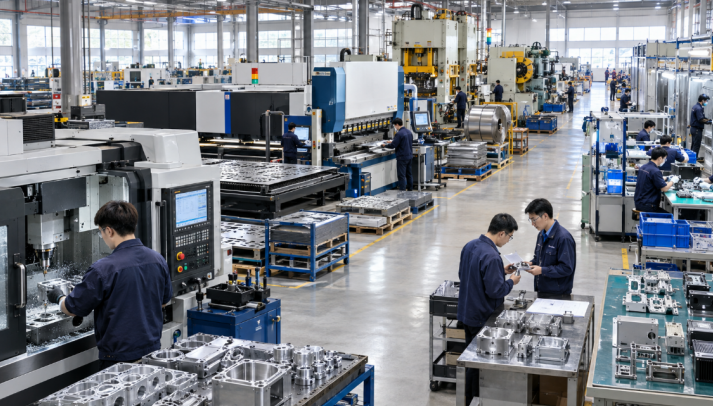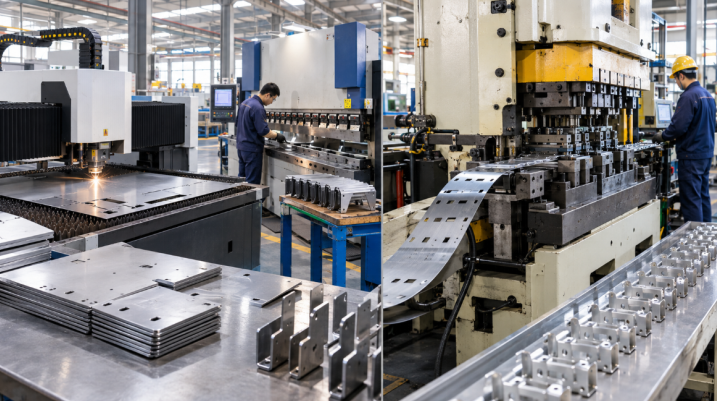
Metal stamping and laser cutting both shape flat sheet metal, but they serve different volumes. Stamping hits the part with a die in one press stroke; laser cutting traces the profile with a beam and no tool at all. The choice comes down to how many parts you need and whether the shape needs real forming force. This guide gives you the factors that matter and a simple way to decide.
Table of Contents
- 1. What Stamping and Laser Cutting Each Do
- 2. Tooling: The Deciding Cost
- 3. Volume and the Crossover
- 4. Tolerances and Edge Quality
- 5. Geometry Each One Handles
- 6. Lead Time to First Part
- 7. A Simple Way to Choose
1. What Stamping and Laser Cutting Each Do
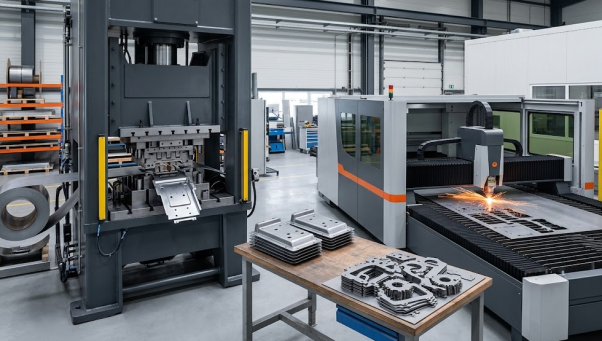
Stamping uses a hardened die in a press. One stroke cuts the blank and can also bend, emboss, or draw it in the same hit. The die is the product, so once it exists the part costs almost nothing per stroke. The detail and force limits are on our hard stamping page.
Laser cutting directs a focused beam along the part outline and blows the cut with gas. There is no die; the shape lives in a program you can change in minutes. For how the cut and bend flow fit together, see our laser cutting page. It is the flexible option for any flat profile.
2. Tooling: The Deciding Cost
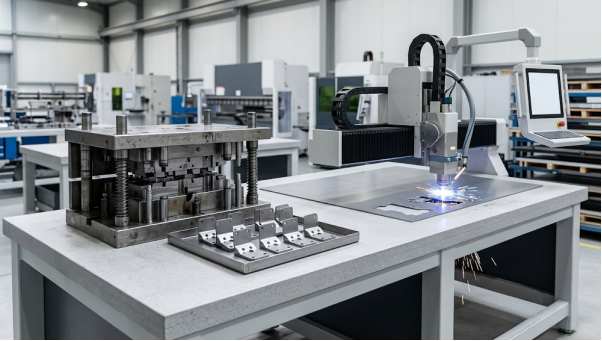
Stamping needs a hardened die built before the first part ships, and that cost sits on the table up front. Laser cutting has no tool, so the only setup is the cutting program, which is nearly free to change. This is why stamping looks expensive at low volume and cheap at high volume: you buy the die once, then pay almost nothing per part, while laser cutting charges machine time on every single piece.
The question is simply whether your volume recovers the die. Because the die cost varies with stations and complexity, the only reliable answer is to quote both at your annual run rather than assume a fixed figure.
3. Volume and the Crossover
Laser cutting usually wins at low and mid volume, because stamping has not yet paid back its die. Above that, the per-stroke cost of stamping drops under laser time, and the gap widens at very high volume where laser is simply too slow and costly. The exact line depends on part size and how many stations the die needs, so price both at your real annual volume to find it.
| Volume | Stamping | Laser cutting |
| Low | Tool cost dominates | Cheapest, no tool |
| Mid | Approaching crossover | Still competitive |
| High | Cheaper per part | Machine time adds up |
| Very high | Far cheaper, high speed | Too slow |
4. Tolerances and Edge Quality
Stamping at Goldconn holds about plus or minus 0.05 mm, and tighter on critical features, with clean sheared edges from the punch. Laser cutting lands around plus or minus 0.1 mm, and tighter on specific features or materials, with smooth, dross-free edges on thin sheet. Because laser has no tool wear, its size stays steady over a long run, while a stamping die is maintained to hold its size as it wears.
For flat profiles where edge finish matters more than cost, laser is the steadier choice. Goldconn confirms every laser-cut feature and bend with CMM and optical inspection, as described on the laser cutting page.
5. Geometry Each One Handles
Laser cutting draws any two-dimensional outline you can program, including slots, tabs, and fine patterns, but it stays flat. To make a three-dimensional shape you bend the cut blank on a press brake as a second step. That combo replaces simple stamping at low volume very well.
Stamping does more in one hit: deep draws, embossing, coining, and multiple bends that laser plus brake would need several operations to match. If the part needs real forming force or a draw depth beyond what bending allows, stamping is the only efficient route. A shop running both, like the scope on our Metal Manufacturing Services page, picks based on the shape rather than the machine.
6. Lead Time to First Part
Laser cutting ships first articles in days because there is no tool, just a program; simple cuts can be ready in just a few days. That makes it the default for prototypes and urgent low-volume runs. Stamping waits on die design and build, typically four to eight weeks at Goldconn for tooling and the initial sample (FAI) before the first good part, so it is a production commitment rather than a quick test.
A practical path is to laser cut the prototype and pilot run, prove the design, then invest in the stamping die once volume is real. This avoids paying for a die on a part that may still change. The same trade appears when you compare machining to forming, covered in our sheet metal fabrication vs hard stamping guide.
7. A Simple Way to Choose
Answer these in order. The first firm answer usually settles it.
- Stable design and volume high enough to pay back a die? Lean stamping.
- Low or mid volume, or design still changing? Lean laser cutting.
- Need deep draw, emboss, or coining in one hit? Stamping.
- Flat profile only, edge finish matters? Laser cutting.
- Urgent prototype this week? Laser cutting, no contest.
When the answer splits, laser cut the early run and plan the die for production. A DFM review before the die is built confirms the draw depths and bend radii so the tool pays back instead of needing rework.
Frequently Asked Questions
What volume makes stamping worth the die?
It depends on part size and die complexity, so there is no single fixed number. Below low volume laser cutting wins because there is no tool; as volume climbs the per-stroke cost of stamping drops under laser time. Quote both at your real annual volume to find the line rather than guessing.
Can laser cutting replace stamping completely?
For flat profiles at low and mid volume, laser cut plus bend replaces simple stamping well and avoids tooling. It cannot match a deep draw, emboss, or coin in one hit, and it costs more per part at high volume. Use it below the crossover, stamp above it.
Which holds tighter tolerance?
Stamping holds about plus or minus 0.05 mm and laser about plus or minus 0.1 mm, both tighter on critical features. Laser stays consistent because there is no tool wear, while a stamping die is maintained to hold its size as it wears. For a flat part where size must stay exact over a long run, laser is the steadier bet.
Why does stamping take weeks to start?
The die must be designed, cut, heat-treated, and trialed, which at Goldconn runs about four to eight weeks before the first good part. Laser cutting skips that with a program. Late or changing designs usually favor laser until the volume is certain.
Can laser cutting make a deep-drawn part?
No. Laser stays in two dimensions; any third dimension needs bending or drawing as a separate step. For a true deep draw or emboss you need stamping or spinning. If the shape is mostly a box with bends, laser cut plus brake is enough.
Which gives a cleaner edge?
Laser edges are smooth and dross-free on thin sheet with no tool wear drift. Stamped edges are clean too but may need deburring on sliding parts. Pick laser when edge finish drives function or appearance.
Should I laser cut prototypes then stamp?
Yes, it is the common path. Laser proves the design in days and covers pilot volume while the die is built. When the run confirms, the same flat pattern feeds the die with only draw and springback changes added. It protects the tool spend.
Do material limits differ between the two?
Both cut the same sheet metals: steel, stainless, aluminum, copper, and brass. Stamping asks more of the material because forming needs ductility, so very hard or brittle sheet may crack in the die. Laser handles those same sheets without forming stress, which is its edge on hard materials.
Is stamping always cheapest at high volume?
Almost always above the crossover, because the per-stroke cost is tiny. But a part that needs a large multi-station die, or one with low material use, may not save as much. The unit price also depends on press tonnage and run length, so price the real part before assuming.
Does the stamping die create an IP risk?
The die encodes your shape, so tool ownership and NDA terms matter. A serious supplier signs an NDA and puts die ownership in your name in the contract, so you can move it if the relationship ends. Confirm that clause before you pay for the tool.
Request a Quote
Not sure whether to stamp or laser cut your part? Send Goldconn your drawing, material, and annual volume for a free DFM review and a 24-hour quote that prices both and tells you the crossover. See the full Metal Manufacturing Services scope, or start on our Custom Metal Components page.