
A procurement team managing an AI data center rack cooling program sends out an engineering drawing for a custom liquid cold plate to three prospective manufacturing partners, expecting firm cost proposals back within days. Instead, all three vendors return extensive lists of clarifying questions regarding raw alloy specifications, surface flatness targets, and test pressures, delaying the supplier shortlist.
Securing accurate supplier quotations on complex thermal components requires a complete and structured request for quotation package. This procurement guide outlines the exact technical and commercial inputs needed to get precise pricing without endless engineering loops.

Table of Contents
- When a Quote Request Comes Back as More Questions
- The Six Inputs Every Custom Liquid Cold Plate RFQ Needs
- Drawings, Tolerances and What to Leave Open for DFM
- Declaring Coolant, Materials and Surface Treatments
- Stating Volume, Prototype and First Article Expectations
- What a Complete Quote Package Should Return
- Conclusion
1. When a Quote Request Comes Back as More Questions
When a purchasing agent dispatches a CAD model without accompanying boundary parameters, suppliers cannot calculate three basic inputs:
- Machine cycle times
- Joining effort
- Inspection overhead
For an AI server rack deployment where tight thermal margins govern reliability, ambiguous RFQs force estimators to quote worst-case scenarios or decline the package entirely.
Bridging the gap between engineering design files and commercial purchasing requires packaging your technical data so that estimators can evaluate machining complexity instantly. Reviewing foundational liquid-to-chip cooling capabilities helps project buyers align their RFQ documents with actual factory workflows.
Audit your current purchasing inquiry templates to ensure technical boundaries accompany every 3D model sent to suppliers.
2. The Six Inputs Every Custom Liquid Cold Plate RFQ Needs
Estimators at precision manufacturing plants evaluate incoming RFQs against a standard checklist of operational variables before releasing numbers to commercial buyers. Omitting even one critical boundary condition forces suppliers to pause their quotation process and request additional clarification.
Project managers can streamline supplier selection by compiling a complete procurement package upfront. Use the RFQ input checklist table below to prepare your next supplier inquiry:
| Input a Buyer Supplies | Why a Supplier Needs It | What Is Missing If Omitted |
|---|---|---|
| 3D STEP Envelope and 2D Drawings | Defines machining depth, pocket profiles, and overall physical dimensions | Estimators cannot calculate CNC cycle times or raw material stock size |
| Thermal Dissipation Targets | Specifies total wattage and localized heat source coordinates | Engineers cannot verify whether machined channels or brazed fins are required |
| Coolant and Wetted Alloy Specs | Identifies chemical compatibility for Al6061, Al6063, or Cu C1100 and fluid loops | Suppliers cannot select proper brazing filler metals or anti-corrosion treatments |
| Operating and Test Pressures | Governs structural wall thickness and proof pressure requirements | Quality teams cannot determine leak testing parameters or proof limits |
| Volume and Delivery Phasing | Establishes whether parts run on CNC job shops or automated cells | Commercial teams cannot quote volume scaling or tooling amortization |
| Acceptance and Quality Terms | Specifies CMM flatness and leak testing expectations | Inspectors cannot account for serialization, helium testing, or audit overhead |
Incorporate this input matrix into your internal project hand-off procedure to ensure every supplier receives identical, complete instructions.
3. Drawings, Tolerances and What to Leave Open for DFM
A common pitfall during preliminary purchasing is locking every internal channel dimension on the drawing before consulting a manufacturing partner, which prevents the shop from applying efficient fabrication methods. While outer envelope dimensions, port locations, and mounting hole patterns must remain strict, internal fin pitch and wall thicknesses benefit from collaborative manufacturing reviews.
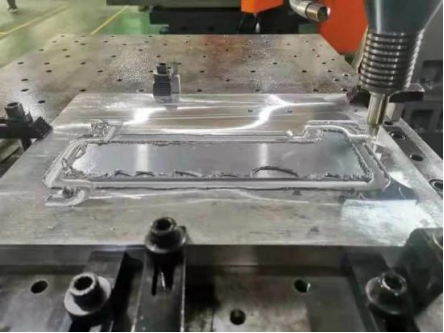
When preparing drawings for a precision cnc machined liquid cold plate factory, buyers should define critical functional interfaces while leaving internal feature layouts open to design for manufacturability optimization. Procurement teams can also reference structured guides to evaluate a liquid cold plate manufacturer before releasing drawings for quotation.
Mark non-critical internal dimensions as reference items and invite supplier engineering teams to suggest optimizations during quotation review.
4. Declaring Coolant, Materials and Surface Treatments
Specifying incomplete material callouts on a purchasing drawing creates severe ambiguity regarding corrosion resistance and fluid compatibility. For AI server loops, state these three items so the supplier can check the wetted path:
- Coolant: water, water-glycol, or dielectric fluid
- Wetted alloy: Al6061, Al6063, or Cu C1100
- Surface treatment: any finishing required on the wetted passages
Your RFQ must explicitly state whether wetted passages require anodizing, electroless nickel plating, or passivation. Furthermore, masking instructions for dry mounting surfaces must be clear to protect thermal contact flatness. When thermal calculations require verification, calculating cold plate cooling capacity requirements beforehand helps validate your material and fluid selections.
List all wetted and non-wetted material callouts clearly in the material notes block of your drawing package.
5. Stating Volume, Prototype and First Article Expectations
Commercial negotiations often stall when buyers request mass-production pricing for an initial batch of evaluation samples, or conversely, when suppliers quote high prototype setup costs for an established serial program. The inquiry should distinguish clearly between initial evaluation samples and recurring volume shipments.
Specify whether your program requires an initial small-batch prototyping run utilizing a nimble small batch cold plate prototyping supplier, followed by serial manufacturing. Clarify your expectations regarding the following quality records so suppliers can factor quality management into their commercial proposal:
- First article inspection reports
- Material mill certs
- Serialized test documentation
Outline your exact pilot and production volume phasing schedule directly in the commercial terms section of your RFQ.
6. What A Complete Quote Package Should Return
When a supplier receives an exhaustive and professional RFQ package, their commercial and engineering response should reflect that clarity with a detailed breakdown of deliverables. Vague email replies offering lump-sum pricing without technical assumptions indicate poor estimation rigor.
A reliable quotation should return a formal commercial proposal that itemizes four inputs:
- Unit price tiers matched to volume forecasts
- Estimated tooling lead times
- Material alloy verification
- A clear statement of included quality reports
To ensure incoming shipments meet high standards, cross-reference your supplier’s promised deliverables against a formal cold plate acceptance tests checklist covering surface flatness and pressure testing.
Require suppliers to submit a formal quotation summary that explicitly itemizes unit pricing, quality documentation, and testing inclusions.
7. Conclusion
Preparing a thorough RFQ package for a custom liquid cold plate program eliminates ambiguous supplier questions, accelerates quotation turnaround, and ensures that returned commercial proposals are directly comparable. Defining precise drawing boundaries, volume phases, and acceptance terms transforms the procurement process from a guessing game into a controlled supply chain onboarding step.
Send your engineering drawing, heat load parameters, envelope dimensions, and coolant declaration to Goldconn today through our contact page for a free DFM review and a 24-hour quote.

Frequently Asked Questions
Why do suppliers return clarifying questions instead of firm quotes when receiving a new cold plate drawing?
Suppliers return questions when incoming RFQs omit critical operational boundaries such as operating pressures, coolant types, volume phasing, or quality inspection standards. Without these parameters, estimators cannot determine machining complexity or testing overhead, forcing them to request clarification before pricing.
What commercial details should be included in an RFQ alongside engineering drawings?
Inquiries should include annual volume forecasts, delivery batch sizing, pilot prototyping quantities, first article inspection requirements, material cert expectations, and required quality documentation such as serialized leak test logs and CMM reports.
How does specifying exact wetted materials prevent delays during cold plate manufacturing?
Explicitly declaring wetted alloys and surface treatments like anodizing or nickel plating prevents suppliers from guessing coolant compatibility. This eliminates engineering change orders and ensures brazed or welded joints meet electrochemical corrosion resistance targets.
Why is it important to separate prototype quotation from serial production pricing in an RFQ?
Prototypes require custom setup, manual fixturing, and engineering oversight that inflate unit costs relative to automated volume production. Separating these phases gives procurement teams clear visibility into tooling amortization and long-term serial unit economics.
What documentation should a buyer expect to receive alongside quoted prototype parts?
Buyers should expect raw material mill certificates, CMM surface flatness inspection reports verifying tolerances such as 0.01 millimeters per 100 millimeters, and serialized pressure decay or helium mass spectrometry leak test logs confirming hermetic sealing.