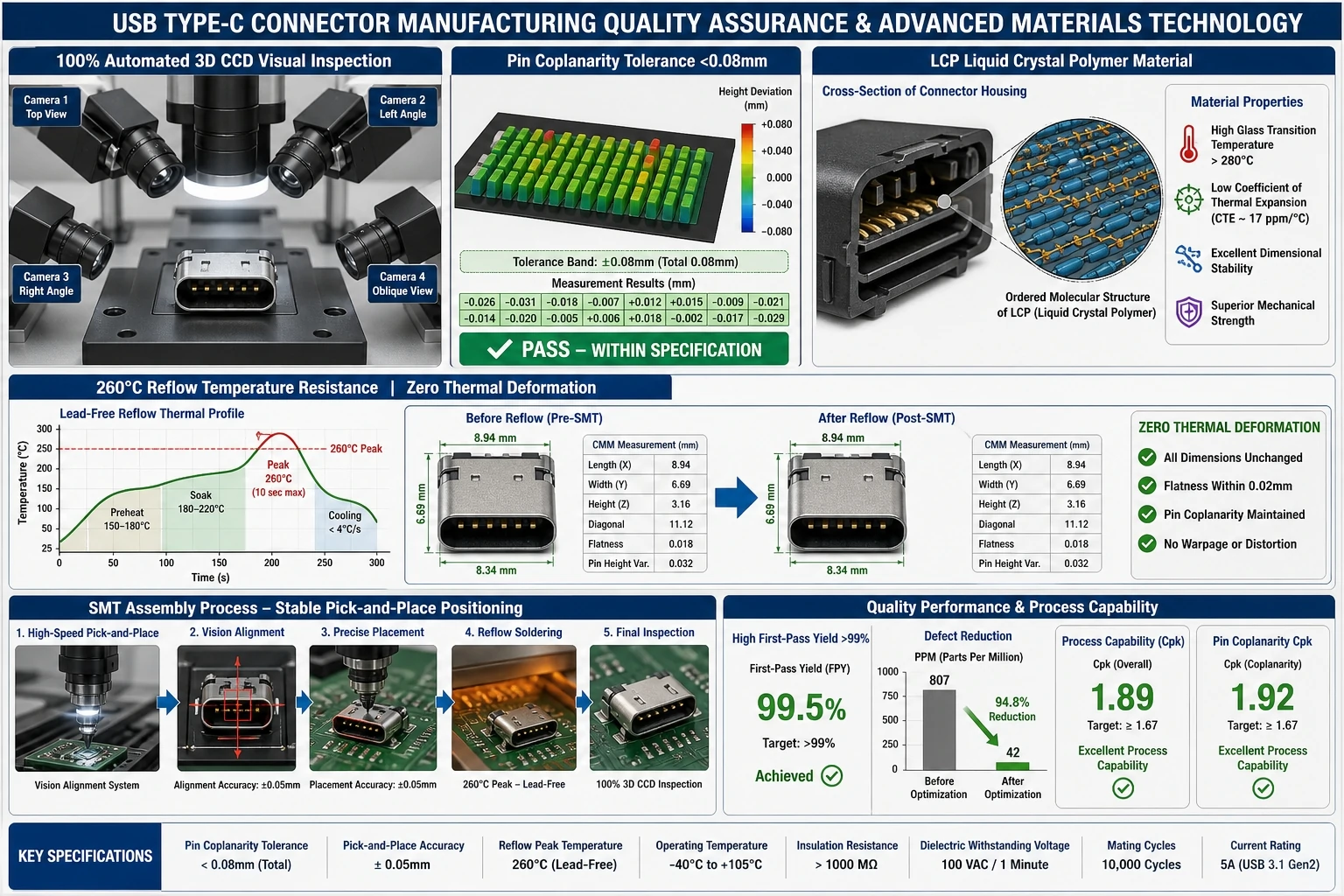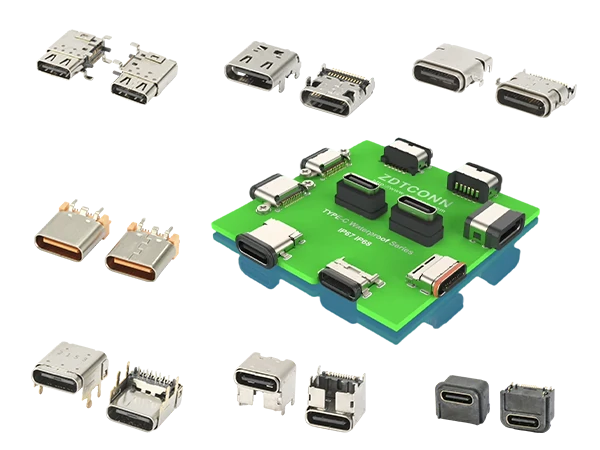
Not every USB-C port is interchangeable. Two devices can expose the same reversible connector while supporting completely different data rates, power levels, and mechanical durability. This article compares USB Type-C against the legacy connectors it replaces, then compares the internal variants—6-pin vs 16-pin vs 24-pin, SMT vs THR, sealed vs unsealed—using first-hand data from the Goldconn USB Type-C connector range.
Table of Contents
- 1. USB-C vs Micro-USB, USB-A, and Barrel Jacks
- 2. 6-Pin vs 16-Pin vs 24-Pin Type-C
- 3. SMT vs THR vs Mid-Mount
- 4. Sealed vs Unsealed Receptacles
- 5. Material and Plating Trade-offs
- 6. Decision Matrix by Application
- Conclusion
- Compare Configurations With Our Team
- Frequently Asked Questions
1. USB-C vs Micro-USB, USB-A, and Barrel Jacks
USB-C has displaced several legacy connector families, but migration is not always plug-and-play. The table below shows where USB-C wins, where it adds complexity, and when a legacy interface may still be the lower-risk choice.
| Connector | Advantages | Limitations | Best Fit Today |
|---|---|---|---|
| USB Type-C | Reversible; USB 3.x/4 data; PD up to 240 W; single ecosystem | Higher BOM cost; requires active PD negotiation; more PCB space than Micro-B | New designs needing data + power in one port |
| Micro-USB | Low cost; mature supply chain | Non-reversible; limited power (max ~25 W); USB 2.0 only | Cost-sensitive, legacy, or power-only products |
| USB-A | Ubiquitous host-side connector; high sourcing volume | Non-reversible; larger footprint; limited power without PD | Host ports, chargers, adapters |
| Barrel jack | Simple, cheap, high current at fixed voltage | No data; non-standardized sizes; no smart power negotiation | Single-voltage DC input where data is unnecessary |
| Lightning / proprietary | Controlled ecosystem and margins | Locked to one brand; regulatory pressure toward USB-C | Brand-specific accessories only |
When USB-C Is the Clear Choice
USB-C is recommended when the product must deliver both data and power through one reversible port, when the roadmap includes USB 3.x or USB4 data rates, or when the end customer expects a modern charging ecosystem. It is also the safer long-term choice for products sold under EU or similar regulations that increasingly mandate a standardized charging interface.
2. 6-Pin vs 16-Pin vs 24-Pin Type-C
Goldconn lists 6-pin, 16-pin, and 24-pin female receptacles. The pin count is the single biggest determinant of what the connector can transport, so it should be decided before footprint and BOM cost.
| Pin Count | USB Standard | Data Rate | Power Notes | Typical Applications |
|---|---|---|---|---|
| 6-pin | USB 2.0 / power-only | 480 Mbps | 3 A typical; limited PD | Wearables, low-cost chargers, power-only modules |
| 16-pin | USB 2.0 + PD | 480 Mbps | 3 A or 5 A; PD up to 100 W / 240 W depending on rating | Smartphones, tablets, mid-power IoT |
| 24-pin | USB 3.1 Gen 2 / USB4 | 10 Gbps and above | 5 A; PD up to 240 W | Laptops, docking stations, industrial vision, medical imaging |
The practical rule is simple: choose 6-pin only when data is not required; choose 16-pin for USB 2.0 with power delivery; choose 24-pin when high-speed data or future-proofing matters. Upgrading later is rarely possible without changing the PCB layout.
3. SMT vs THR vs Mid-Mount
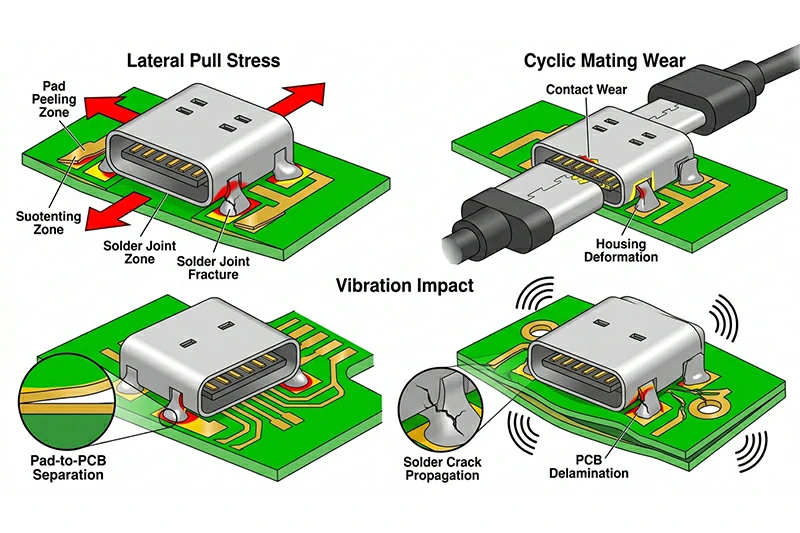
Mounting style determines how insertion and cable-pull forces transfer into the board. Goldconn emphasizes a 6-leg THR design with 360° laser seamless welding, citing a 40% torque-resistance improvement and elimination of pad peeling. The comparison below explains why that matters.
| Mounting Style | Mechanical Strength | Profile | Best Use |
|---|---|---|---|
| SMT | Moderate; relies on solder joints | Lowest | Smartphones, slim consumer devices |
| THR | High; through-hole legs anchor to PCB | Taller than SMT | Industrial, automotive, medical, frequent insertion |
| Mid-mount | Moderate to low | Very low | Ultra-thin products; verify retention with accelerated life tests |
4. Sealed vs Unsealed Receptacles
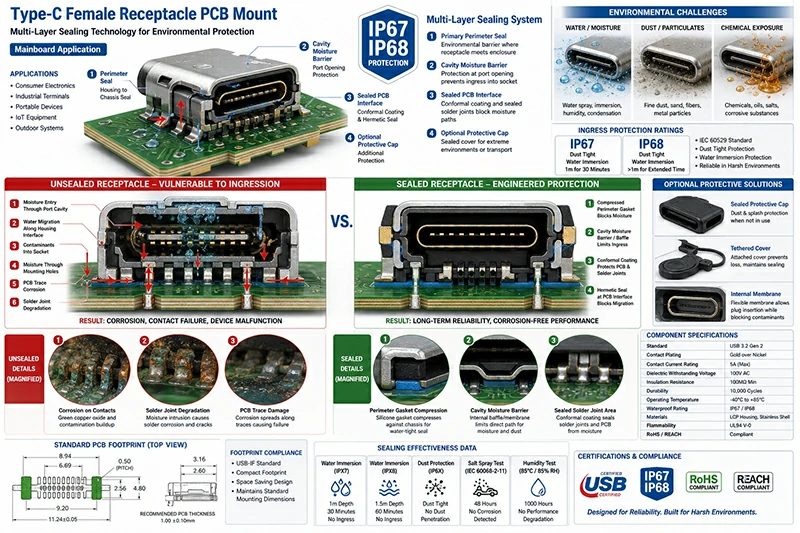
Goldconn provides IPX4 splashproof and IPX8 submersible connectors using LSR internal sealing and perimeter gaskets. Sealing adds cost and requires system-level validation, so it should be specified only where it is genuinely needed.
Sealing Decision Rules
- Unsealed—indoor consumer electronics with no liquid exposure; lowest cost.
- IPX4—occasional splash, kitchen appliances, light outdoor use where full immersion is unlikely.
- IPX8—outdoor infrastructure, marine, washdown equipment, medical devices exposed to cleaning or sterilization fluids.
5. Material and Plating Trade-offs
Goldconn specifies C7025 copper alloy terminals with 30 µ” localized gold plating over nickel, a stainless-steel shell, and LCP housing. These choices are not arbitrary: C7025 offers a balance of conductivity and spring force; localized gold keeps contact resistance low without plating the entire terminal; and LCP survives reflow temperatures while maintaining dimensional stability.
| Material / Feature | Purpose | Risk of Downgrading |
|---|---|---|
| C7025 copper alloy | Conductivity + spring force for mating cycles | Higher contact resistance, earlier fatigue |
| 30 µ” localized gold | Low contact resistance, corrosion resistance | Wear-through, oxidation, intermittent contact |
| Stainless-steel shell | EMI shielding, mechanical stiffness | Deformation, poor shielding, insertion damage |
| LCP housing | High-temperature reflow stability | Warping during reflow, coplanarity loss |
6. Decision Matrix by Application
| Application | Pin Count | Mounting | Sealing | Power Class |
|---|---|---|---|---|
| Wearable / low-cost charger | 6-pin | SMT | Unsealed | 15–25 W |
| Smartphone / tablet | 16–24 pin | SMT | Unsealed / IPX4 | 18–100 W |
| Industrial HMI / sensor | 16–24 pin | THR | IPX4 / IPX8 | 15–100 W |
| Automotive console / diagnostics | 24-pin | 6-leg THR + laser weld | IPX4+ | 60–240 W |
| Medical cart / portable instrument | 16–24 pin | THR | IPX8 | 15–100 W |
Conclusion
USB-C is not a single connector; it is a family of options built around a common shell. The right variant is determined by data rate, power class, mechanical load, and environmental exposure. For a step-by-step selection process, see the USB Type-C connector selection guide.
Compare Configurations With Our Team
Tell us which connector family you are comparing—Micro-USB, USB-A, barrel jack, or internal Type-C variants—and your application conditions. We will recommend a 6-pin, 16-pin, or 24-pin configuration, mounting style, and sealing level, then provide samples and a quotation for direct testing.
Frequently Asked Questions
Can I replace a Micro-USB port with USB-C without changing the PCB?
Usually not. USB-C requires more pins, a different footprint, and often additional components for CC pull-downs or PD negotiation. Plan for a board respin and firmware update.
Is a 24-pin connector always better than 16-pin?
Not if the product only needs USB 2.0 and moderate power. A 24-pin connector adds cost, board space, and routing complexity. Choose pin count based on the actual data-rate requirement.
Does THR increase board height?
Yes, THR legs protrude through the board and are reflowed on both sides, so the assembly is slightly taller than a pure SMT connector. The trade-off is significantly higher mechanical retention.
Can an unsealed USB-C connector survive a dusty factory?
An unsealed connector can survive low-dust indoor environments, but exposed contacts in heavy particulate or washdown areas will eventually fail. For harsh environments, specify at least IPX4 and validate with dust and humidity testing.
What makes C7025 copper alloy suitable for USB-C terminals?
C7025 offers a favorable combination of electrical conductivity and spring force, which is essential for maintaining reliable contact pressure across thousands of mating cycles and over a wide temperature range.
How does USB-C compare to barrel jacks for power-only devices?
USB-C adds reversible insertion, standardized voltage negotiation, and the option to carry data, but it costs more and requires active PD circuitry. Barrel jacks remain simpler and cheaper for fixed-voltage DC input where data is unnecessary.
Why is 360° laser welding mentioned for THR connectors?
360° laser seamless welding joins the upper and lower shell halves into a single rigid structure. This improves EMI shielding continuity, torque resistance, and resistance to shell deformation under insertion forces.