A custom heatsink manufacturer turns your thermal targets into a part that fits, cools, and ships on time. The wrong partner means rework, leaks, or a part that misses its temperature limit. Before you shortlist suppliers, read our liquid cold plate vs heatsink comparison to confirm which cooling method you need, then judge suppliers against the points below.
- 1. Build a Supplier Scorecard
- 2. Process Range: Build the Right Heatsink
- 3. Engineering and Thermal Simulation
- 4. Quality System and Inspection
- 5. What to Put in Your RFQ
- 6. Cost Drivers and How to Save
- 7. Application Fit by Industry
- 8. Lead Time, Volume, and Communication
- 9. Why Goldconn
1. Build a Supplier Scorecard
Score suppliers on the same axes so comparisons stay honest: in-house process range, thermal analysis, machining precision, certified quality system, prototyping speed, and communication. A shop strong on only one axis will bottleneck your program. See the full custom heatsink manufacturing capabilities to understand what each process covers.
| Axis | What to verify | Why it matters |
|---|---|---|
| Process range | Extrusion, skive, forge, cast in-house | Right path for your load and volume |
| Thermal analysis | CFD, FEA, airflow test | Proves cooling before tooling |
| Precision | Flatness, finish, CMM data | Seals and assembles correctly |
| Quality system | ISO, IATF16949, traceability | Automotive and medical trust |
| Prototyping speed | Fast first article | Faster validation loop |
| Communication | DFM feedback, clear contact | Fewer surprises in production |
2. Process Range: Build the Right Heatsink
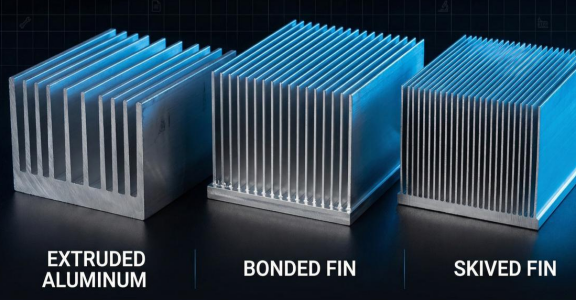
One process rarely fits every heatsink. A supplier that runs several of these in-house can pick the best path for your load and volume. Some programs also need liquid cold plates for high-power density, so ask whether the same partner can build both.
| Process | Best for | Limit to ask about |
|---|---|---|
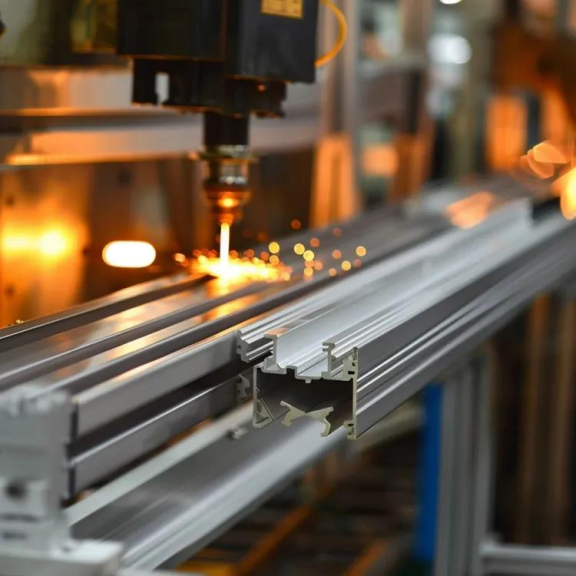
| Extrusion | Long straight fins in volume | Fin aspect ratio capped by press |
| Skived fin | Very thin fins, tight spaces | Base size follows machine envelope |
| Cold forging | Dense, odd-shaped fins | Geometry must be forge-able |
| Die casting | Complex shapes at scale | Tool cost pays back at volume |
| Bonded fin, heat pipe | Tall fins, hot spots | Joint quality and bond strength |
2.1 Process Limits and How They Shape Cost
Each process also carries a trade most buyers miss. Extrusion is cheap but limited in fin height; skiving packs fins but is bound to the machine bed size; die casting frees shape but adds tooling that only pays back across volume; cold forging gives strength but few geometries. Knowing these limits up front stops a supplier from quoting a process that cannot actually make your part.
3. Engineering and Thermal Simulation
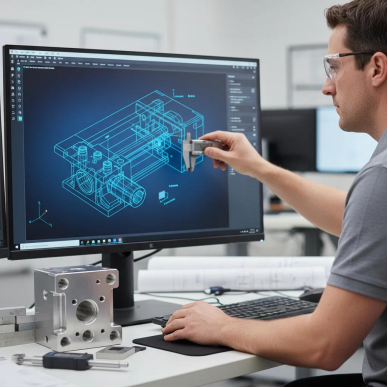
Cooling is easier to prove on a screen than after tooling. A capable partner uses CFD and FEA simulation to test materials and fin shapes before building, then validates the prototype with airflow testing and thermal imaging. Goldconn offers this analysis as part of its custom metal fabrication services, so the design is checked before you commit to volume.
Ask to see the simulation assumptions: heat load, ambient, airflow, and the temperature limit. If the supplier cannot state these, the “cooling” claim is untested. A real model also tells you which fin type actually wins for your geometry, instead of guessing from a catalog.
4. Quality System and Inspection
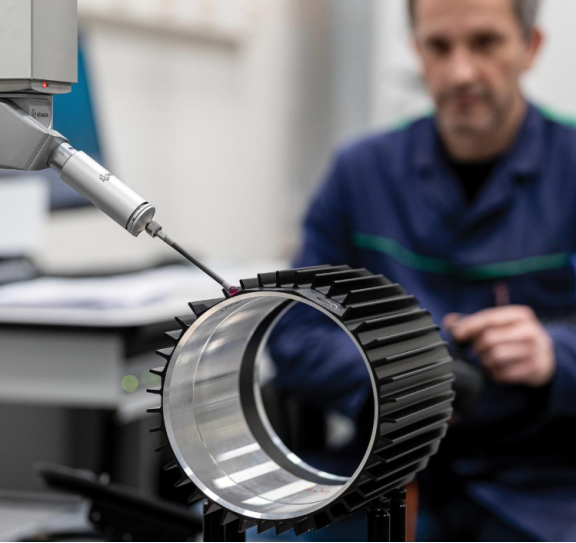
For automotive or medical use, the quality system matters as much as the fins. Look for ISO 9001, ISO 14001, ISO 45001, QC 080000, and IATF 16949, plus RoHS and REACH compliance. Check that the shop verifies incoming alloy by spectral analysis and hardness testing, measures parts on CMM and optical systems, and leak-tests sealed parts by pressure decay. Goldconn applies all of these and keeps full material and process traceability per batch.
4.1 Inspection Checks That Protect You
- Material verification: spectral analysis confirms the alloy grade before cutting.
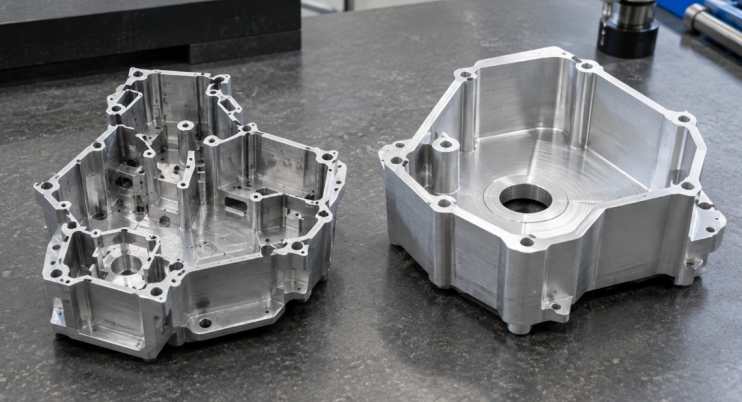
- Dimensional check: CMM and optical systems confirm size and flatness.
- Leak test: pressure-decay or helium test on sealed assemblies.
- Traceability: per-batch records link material to the finished part.
5. What to Put in Your RFQ
| Item | Why the supplier needs it |
|---|---|
| Heat load in watts | Sizes the fin area and material |
| Temperature limit to hold | Defines the cooling target |
| Space, height, mounting | Constrains fin geometry |
| Material and finish | Affects sourcing and cost |
| Airflow condition | Natural, fan, or sealed |
| Target volume | Picks the process |
| CAD files | Enables DFM and quote |
6. Cost Drivers and How to Save
Heatsink cost follows material grade, process, fin complexity, tolerance, and volume. Die casting adds tooling that pays back only at volume; extrusion and skiving scale differently. You save most by matching the process to volume and by relaxing tolerance to what the function needs. Goldconn maps the cheapest capable path during the DFM review rather than quoting a one-size process.
7. Application Fit by Industry
| Industry | Cooling need | Typical method |
|---|---|---|
| EV charging | High power density | Cold plate or dense fin |
| Medical | Reliable, clean | Skived or forged fin |
| Industrial IoT | Steady, low cost | Extruded heatsink |
| Telecom | High heat flux | Cold plate or bonded fin |
| Power supply | Moderate load | Extruded or stamped |
8. Lead Time, Volume, and Communication
Ask two practical questions: how fast can I get a prototype, and will volume scale without a quality drop. Goldconn supports flexible minimum order quantities from prototype runs to high volume, and clear DFM collaboration from the first call keeps both on track. Explore the broader metal manufacturing services for the full program scope.
9. Why Goldconn
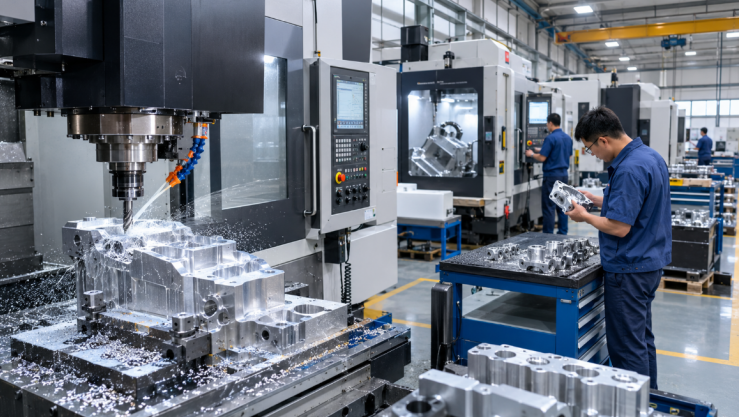
Goldconn pairs in-house heatsink and cold-plate processes with simulation and a certified system, so one partner covers prototype to volume. Three facilities totaling 58,000 m2, 300 plus machines including 150 CNC centers, and 800 plus staff support the work, with CFD, FEA, CMM, and 100 percent leak testing on sealed parts.
Frequently Asked Questions
- Should I use one supplier for heatsinks and cold plates? If your products use both, a single partner simplifies DFM, sourcing, and quality. Goldconn builds both in-house.
- What do I send to get a quote? Heat load, temperature limit, available space, material preference, volume, and any CAD files. The more detail, the tighter the quote.
- Can a manufacturer help with the design? Yes. Thermal simulation and DFM feedback before tooling save the most cost and time.
- Are small batches supported? Goldconn supports prototype and low-volume runs, not just mass production.
- How fast is the quote? Goldconn returns a free DFM review and a quote within 24 hours of receiving your requirements.
- Which process is cheapest? It depends on volume and shape. Extrusion suits volume; skiving suits tight spaces; die casting suits complex shapes at scale.
- Can you inspect incoming material? Yes. Goldconn verifies alloy by spectral analysis and hardness testing before production.
- Do you support automotive grades? Yes. Processes follow IATF 16949 alongside the other ISO standards.
Request a Free DFM Review
Ready to shortlist a heatsink manufacturer? Send Goldconn your thermal targets and drawings. You get a free DFM review and a quote within 24 hours, with simulation and prototype support from prototype to production.