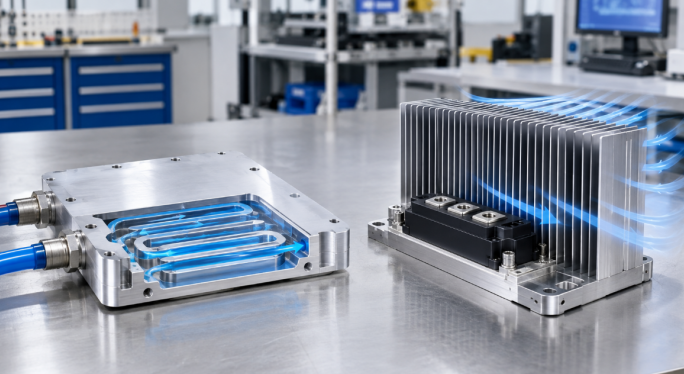
A liquid cold plate and an air-cooled heatsink both move heat away from electronics, but they work in fundamentally different ways. A heatsink spreads heat into fins that surrounding air carries off. A liquid cold plate carries heat into a flowing coolant through sealed internal channels. Choosing wrong means you either overspend on plumbing you do not need or ship a part that crosses its temperature limit under load. This guide explains how each method works, where it fits, and how to decide, drawing on Goldconn’s in-house thermal program within its custom metal fabrication services.
- 1. How a Liquid Cold Plate Works
- 2. How an Air-Cooled Heatsink Works
- 3. Liquid Cold Plate vs Heatsink: Side-by-Side
- 4. How to Choose the Right Cooling Method
- 5. Where Each Method Is Used
- 6. Goldconn’s Thermal Manufacturing Support
1. How a Liquid Cold Plate Works
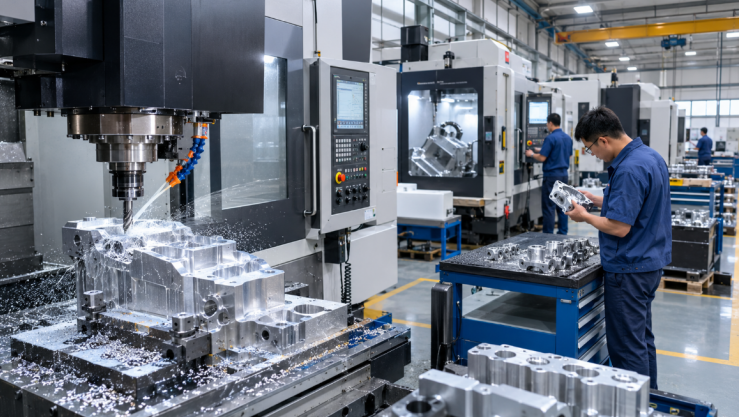
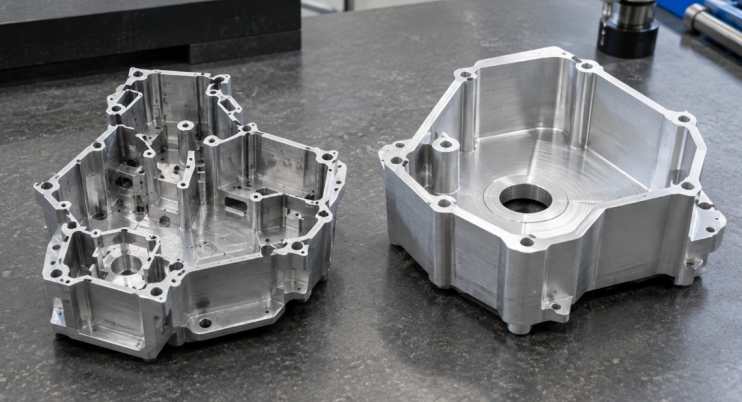
A liquid cold plate is a metal slab with internal channels milled into it. Coolant flows through those channels and picks up heat from the component mounted on the plate surface. Goldconn machines these channels on multi-axis CNC centers and seals them with friction stir welding (FSW) or vacuum brazing, so the plate stays leak-free under pressure.
1.1 Core Parts of a Cold Plate
- Base plate: the machined block the component bolts to; flatness is machined to about 0.01 mm per 100 mm so the contact face sits tight against the heat source.
- Internal channels: the paths the coolant travels; their shape decides how evenly heat is removed.
- Manifold or cover: closes the channels and directs flow in and out.
- Fittings: push-to-connect, threaded, or brazed ports that join the plate to the loop.
1.2 Flow Path Topologies
Three layouts dominate. Parallel channels give even cooling across a wide part but need a good inlet distribution. A serpentine path forces coolant through a long single route, raising pressure drop but simplifying the manifold. Pin-fin or drilled inserts stir the flow for hot spots that need aggressive removal. The right choice depends on where heat sits and how much pump head your system can spare.
1.3 Coolants and Sealing
Coolant is usually water, a water-ethylene glycol mix, or a dielectric fluid when electrical isolation matters. Base materials are aluminum alloys such as Al6061 and Al6063, or copper C1100 for higher conductivity. Because a leak can destroy the electronics it protects, every plate is pressure-decay or helium mass-spectrometry tested before it ships. See the full part range on the liquid cold plate page.
2. How an Air-Cooled Heatsink Works
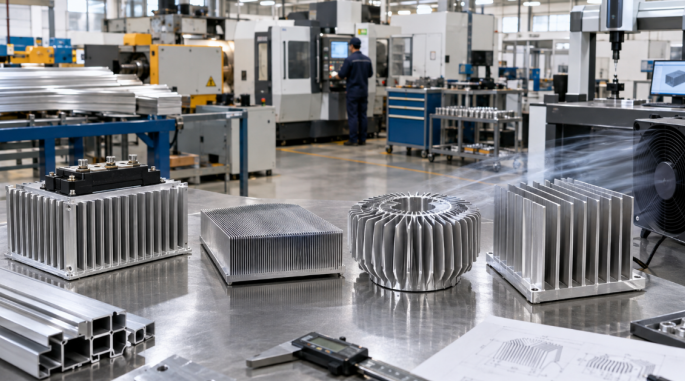
An air-cooled heatsink is a block of metal with fins. Heat travels from the device into the base, then spreads up the fins where air carries it away. Moving air from a fan raises the heat it can move. The physics is simple: more fin surface and more airflow means more heat carried off, until you hit the point where adding fins just blocks the air. Goldconn builds heatsinks by extrusion, skiving, bonded fin, cold forging, and die casting, then checks performance with airflow testing and thermal imaging. You can see the full range on the custom heatsink manufacturing page.
2.1 Fin Types and the Trade-Off Behind Them
- Extruded: long straight fins, economical for steady high-volume cooling.
- Skived fin: very thin fins cut from one block, packing surface into tight spaces.
- Cold forged: dense, odd-shaped fins for omnidirectional airflow.
- Die cast: complex shapes in volume once a tool is made.
- Bonded fin and heat pipe: tall fins or fast heat spread for hot spots.
2.2 Natural vs Forced Convection
Without a fan, a heatsink relies on rising warm air, which limits how much it can move. A fan or blower multiplies that many times over but adds noise, power draw, and a moving part that can fail. The choice between passive and forced air is one of the first things to settle when you size a sink.
3. Liquid Cold Plate vs Heatsink: Side-by-Side
| Factor | Liquid cold plate | Air-cooled heatsink |
|---|---|---|
| Cooling method | Coolant fluid through sealed channels | Air over fins, natural or forced |
| Heat it handles | High heat flux, power-dense parts | Low to moderate heat loads |
| Moving parts | Needs pump and plumbing | Passive; fan only if forced air |
| Sealing and risk | Sealed; 100% leak tested | None |
| Build path | CNC plus FSW or vacuum brazing | Extrusion, skive, forge, or die cast |
| Space needed | Thin plate plus external loop | Fin stack takes height and footprint |
| Best fit | Compact, sealed, high-density power electronics | Open spaces with steady airflow |
4. How to Choose the Right Cooling Method
Start with the heat you must remove and the space you have. If the part packs a lot of power into a small box with little airflow, a liquid cold plate usually wins. If the device sits in open air with room for fins, a heatsink is simpler and cheaper to run. If you are narrowing down a supplier, see our guide on choosing a custom heatsink manufacturer.
4.1 Questions to Answer First
- What is the heat load and the temperature limit you must hold?
- Is there steady airflow, or is the enclosure sealed?
- How much space and height can the cooling part use?
- Can your system accept a pump, fluid lines, and leak checks?
- What volume and unit cost do you need at production?
- Is the heat spread evenly, or concentrated in a few hot spots?
4.2 Matching Method to Situation
As a practical guide rather than a fixed line: sealed enclosures with power-dense parts point to cold plates; open frames with steady air point to heatsinks. Mixed cases, such as a sealed box with a modest load, need a real thermal model, which is why simulation matters before tooling.
5. Where Each Method Is Used
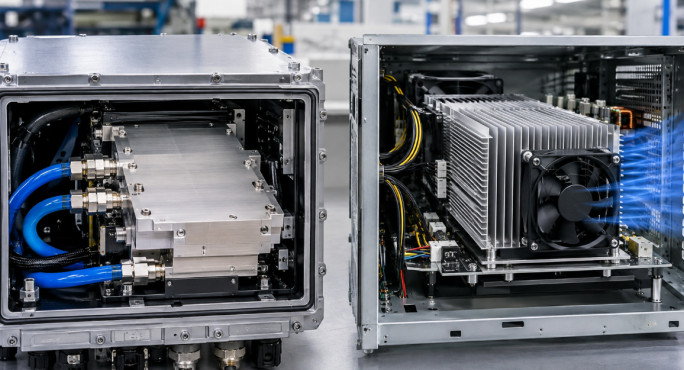
Liquid cold plates show up where power is high and air is not. EV charging modules, IGBT and SiC power stages, medical laser heads, and telecom amplifiers are common. Air-cooled heatsinks cover broader ground: motor drives, LED lighting, power supplies, and industrial controllers that sit in ventilated cabinets. The same OEM often uses both across a product line, which is why sourcing from one partner helps.
6. Goldconn’s Thermal Manufacturing Support
Goldconn makes both cold plates and heatsinks in-house, so you can source from one partner as your design changes. The company runs three facilities totaling 58,000 m2 with 300 plus machines, including 150 CNC centers, and 800 plus staff. Processes follow ISO 9001, ISO 14001, ISO 45001, QC 080000, and IATF 16949. Engineering includes CFD and FEA simulation, CMM inspection, and 100 percent leak testing on sealed parts. See the full scope on the metal manufacturing services page.
Frequently Asked Questions
- When should I pick a cold plate over a heatsink? Choose a cold plate when the part is power-dense and airflow is limited. Pick a heatsink when there is open space and steady air.
- Can one supplier build both? Yes. Goldconn machines cold plates and forms heatsinks in-house, which helps when a program uses both methods.
- How long does a custom thermal part take? Lead time depends on the process and volume. Goldconn offers fast prototypes and scales to volume production.
- Is leak risk a concern with cold plates? Sealed plates are pressure-decay or helium tested, so leaks are caught before shipping.
- Do cold plates need special coolant? It depends on isolation needs; water, glycol mix, or dielectric fluid are all options your system design decides.
- Which fin type is best? It depends on space and airflow. Skived fins suit tight spaces; extruded suit volume; bonded fin suits tall fins.
- Can you simulate before I build? Yes. Goldconn runs CFD and FEA so the design is checked before you commit to volume.
- How do I get a quote? Send your heat load, space, material, and volume. Goldconn returns a free DFM review and a quote within 24 hours.
Request a Free DFM Review
Not sure whether a liquid cold plate or a heatsink fits your design? Send Goldconn your drawings and thermal targets. You get a free DFM review and a quote within 24 hours, with simulation and prototype support from prototype to production.