To choose a TFT LCD display module correctly, start from the operating environment and the product lifecycle, then match size, brightness, interface, touch, and temperature to those constraints. The single most common failure is selecting on price and discovering sunlight readability, EOL, or touch behavior problems only after tooling is committed. This guide gives a specification-by-specification selection framework you can apply before contacting a supplier.
Table of Contents
- 1. Define the Operating Environment First
- 2. Size and Resolution: Match Pixels to Viewing Distance
- 3. Brightness and Optical Bonding for Readability
- 4. Interface Selection: RGB vs LVDS vs MIPI
- 5. Touch: Resistive vs Capacitive and Glove Support
- 6. Temperature and Mechanical Durability
- 7. Lifecycle and Supply Assurance
- 8. Selection Decision Framework
- Conclusion
- Frequently Asked Questions
1. Define the Operating Environment First
Before comparing panels, write down the three constraints that eliminate options fastest: ambient light level, temperature range, and expected production lifespan. A module for an indoor medical terminal and one for an outdoor EV charger are different products even at the same diagonal.
Standard TFT modules span 2.0 inch to 6.85 inch, while larger TFT LCD display modules span 7 inch to 23.8 inch. The full capability range and applications are described on the Goldconn TFT LCD Display Module page; this article focuses on how to choose within that range.
2. Size and Resolution: Match Pixels to Viewing Distance
Diagonal size sets the physical footprint; resolution sets legibility. For a fixed diagonal, higher resolution improves text sharpness but raises controller and EMI complexity. Match the resolution to the typical viewing distance and the amount of on-screen information.
| Application | Typical Diagonal | Selection Priority |
|---|---|---|
| Wearable / sensor readout | 2.0–3.5 inch | Low power, small footprint, simple interface |
| Handheld medical / test equipment | 3.5–7 inch | Contrast, touch accuracy, EMI control |
| Industrial control / kiosk | 7–15.6 inch | Sunlight readability, wide temp |
| Automotive / large HMI | 10.1–23.8 inch | Extended temp, bonding, long lifecycle |
A 7-inch 1024×600 panel is recommended when the user reads dense menus at arm’s length; an 800×480 panel is more suitable when the UI is icon-driven and cost is tight.
3. Brightness and Optical Bonding for Readability
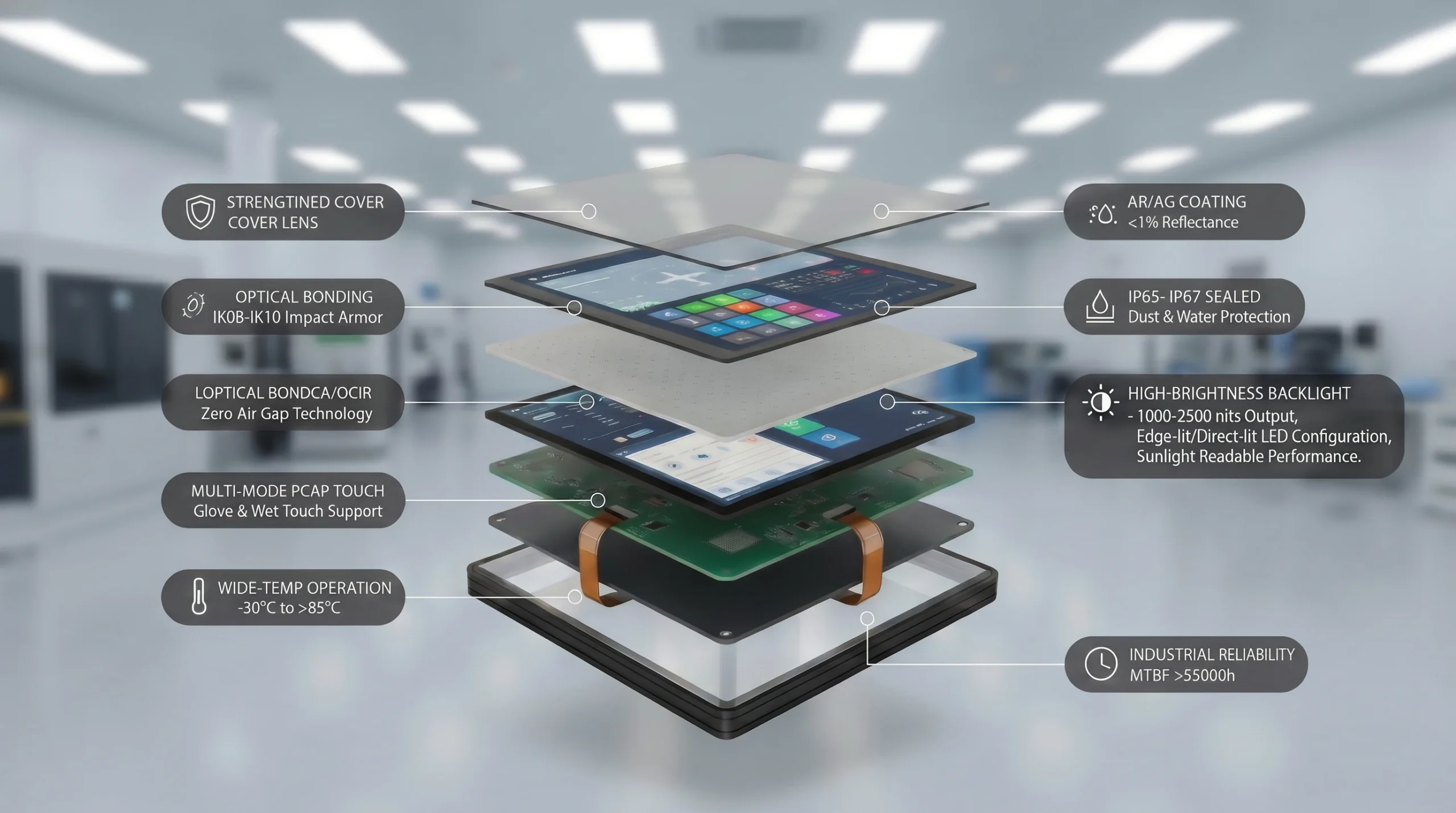
Brightness is the most misunderstood spec. Industrial sunlight-readable modules use custom LED arrays delivering 800 to 1500 nits, with contrast ≥1000:1. But raw nits do not guarantee outdoor readability if an air gap exists between the touch panel and the LCM—ambient light reflects off that gap and washes out the image.
OCA (Optical Clear Adhesive) full lamination eliminates the air gap, reducing reflectance to ≤2% and improving contrast by 15–20%. Specify OCA bonding whenever the device operates in direct sunlight. Optical parameters to require: luminance 800–1500 nits, contrast ≥1000:1, transmittance ≥90%, reflectance ≤2%.
4. Interface Selection: RGB vs LVDS vs MIPI
The module-to-host interface affects EMI, cable length, and processor pin budget. RGB, LVDS, and MIPI are all supported, and custom interface-conversion layouts (e.g., HDMI/VGA to LVDS/MIPI) are available.
| Interface | Best For | Watch-Out |
|---|---|---|
| RGB | Short on-board links, cost-sensitive MCU designs | Limited cable length, higher EMI at speed |
| LVDS | Longer cables, industrial EMI environments | Needs SerDes and shielding design |
| MIPI | Modern application processors, compact designs | Strict lane routing and ESD discipline |
LVDS is recommended for factory-floor equipment with cable runs and electrical noise; MIPI is more suitable when the host is a modern SoC and board space is limited. See the comparison guide for the full trade-off analysis.
5. Touch: Resistive vs Capacitive and Glove Support
Industrial capacitive touch (CTP) using premium ICs from Goodix, ILITEK, and EETI enables multi-touch even with thick industrial gloves or wet hands, and supports 19 industrial glove types through high signal-to-noise-ratio tuning. CTP thickness is 1.2–2.5 mm, with an ITO sensor layer of 100–150 nm on 0.55/0.7/1.1 mm substrates.
Capacitive touch is recommended for modern HMIs needing glove and wet-hand operation; resistive touch remains suitable only for legacy systems or stylus-only, gloved-but-no-multitouch use where cost dominates.
6. Temperature and Mechanical Durability
Extended thermal tolerance covers −30°C to +85°C, with component selections reaching −40°C to +105°C for harsh duty. Cover-lens hardness reaches ≥9H or ≥9.5H, with lens thickness from 1.0–6.0 mm (up to 10 mm) for vandal-resistant outdoor enclosures. MTBF exceeds 50,000 hours.
Specify −40°C to +105°C only where the BOM and backlight genuinely support it; overspecifying without verification creates supply risk. Require the supplier to document the actual temperature-grade components used.
7. Lifecycle and Supply Assurance
For industrial, medical, and automotive programs, lifecycle policy outweighs panel price. Require a 5–10 year longevity framework, BOM lock on the glass substrate, driver ICs, touch-sensor pattern, controller chipset, and polarizer, and a formal PCN 6–12 months in advance if an EOL event occurs. Tier-1 panel allocations (BOE, AUO, Innolux, HannStar, IVO, Tianma) reduce allocation risk.
8. Selection Decision Framework
- Indoor, stable temperature, short lifecycle → standard brightness, RGB or MIPI, basic CTP.
- Outdoor / sunlight → 800–1500 nits + OCA bonding, reflectance ≤2%.
- Factory / automotive EMI → LVDS, shielded stack-up, extended temp.
- Glove or wet-hand operation → CTP with Goodix/ILITEK/EETI, SNR tuning.
- 5–10 year program → BOM lock, PCN 6–12 months, written longevity commitment.
Conclusion
Selecting a TFT LCD module is a constraint-driven process: environment first, then size/resolution, brightness with bonding, interface, touch, temperature, and finally lifecycle assurance. Capture each requirement in writing before requesting quotes so suppliers can return compatible options instead of the cheapest panel. Return to the TFT LCD module buyer’s guide for the full decision map.
Request a Compatibility Review
Send us your size, brightness, interface, touch, temperature, and lifecycle requirements. Our R&D team will review them and return official engineering drawings for approval within 3–5 business days, along with a sample evaluation plan and quotation. You can also review the TFT LCD Display Module capabilities before sending your inquiry.
Frequently Asked Questions
How much brightness is enough for outdoor use?
Specify 800–1500 nits together with OCA bonding. Brightness below 800 nits is risky for direct sun, and without bonding the air gap still causes glare even at high nits.
Is OCA bonding necessary for indoor equipment?
Not always. Indoor, controlled-light terminals can use air-gap assembly to save cost, but OCA still improves contrast and dust immunity. Reserve OCA for sunlight-exposed or high-contrast-critical uses.
Can capacitive touch work with industrial gloves?
Yes, when the controller IC (Goodix, ILITEK, EETI) is tuned for high SNR and the stack-up is specified for glove use. 19 industrial glove types are supported in the described capability set.
Which interface is best for long cable runs?
LVDS is preferred for longer, noise-prone industrial cables because it is differential and EMI-tolerant. RGB should stay on short on-board links.
How do I protect against panel EOL?
Require BOM lock plus a written PCN commitment of 6–12 months and a 5–10 year availability framework. This lets you qualify a pin-to-pin alternative before stock runs out.
What temperature grade do I actually need?
−30°C to +85°C covers most industrial and automotive cabin uses; −40°C to +105°C is for under-hood or extreme outdoor duty. Only specify the wider range if the BOM genuinely supports it.