The right display technology depends on environment, lifetime, and total cost of ownership—not on which panel is cheapest per unit. TFT LCD modules win for color, wide-temperature industrial HMIs with 5–10 year lifecycles, but OLED, TN, and resistive-touch options each have a place. This comparison explains where TFT LCD fits, how RGB/LVDS/MIPI interfaces differ, and what the trade-offs cost you in the field.
Table of Contents
- 1. TFT LCD vs OLED vs TN: Where Each Belongs
- 2. Interface Comparison: RGB vs LVDS vs MIPI
- 3. Touch Comparison: Capacitive vs Resistive
- 4. Bonding Comparison: Air-Gap vs OCA Full Lamination
- 5. Brightness and Sunlight Readability
- 6. Cost-of-Ownership Trade-Offs
- 7. Decision Rules
- Conclusion
- Discuss Your Display Stack
- Frequently Asked Questions
1. TFT LCD vs OLED vs TN: Where Each Belongs
TFT LCD is recommended for long-lifecycle industrial, medical, and automotive HMIs because it scales from 2.0 to 23.8 inches with stable driver ecosystems, 800–1500 nits sunlight readability, and ≥1000:1 contrast, as described on the Goldconn TFT LCD Display Module page. OLED offers deeper black and thinner stacks but faces burn-in and supply-longevity risk for multi-year programs. TN panels are low-cost but suffer narrow viewing angles and poor contrast outdoors.
| Technology | Advantages | Limitations | Best Application |
|---|---|---|---|
| TFT LCD (IPS-type) | Color, wide temp, 5–10 yr supply, 800–1500 nits | Higher power than reflective; needs backlight | Industrial, medical, automotive HMI |
| OLED | True black, thin, fast | Burn-in, EOL/supply risk, cost | Short-life premium consumer |
| TN LCD | Lowest cost | Narrow viewing angle, low contrast | Static indoor readouts |
2. Interface Comparison: RGB vs LVDS vs MIPI
Module-to-host signaling is a frequent source of EMI and reliability problems. The three industrial-relevant interfaces are RGB, LVDS, and MIPI.
| Evaluation Factor | RGB | LVDS | MIPI |
|---|---|---|---|
| Cable length | Very short (on-board) | Long | Medium |
| EMI behavior | Poor at speed | Good (differential) | Good with discipline |
| Host support | MCUs, FPGAs | Industrial SoCs | Modern app processors |
| Recommendation | Cost-sensitive, short link | Noisy factory / long run | Compact SoC designs |
LVDS is recommended for factory-floor equipment with electrical noise and cable runs; MIPI is more suitable when the host is a modern SoC and board space is limited. Custom HDMI/VGA-to-LVDS/MIPI conversion layouts are available when the host and panel interfaces do not match natively; the step-by-step interface selection is in the TFT LCD module selection guide.
3. Touch Comparison: Capacitive vs Resistive
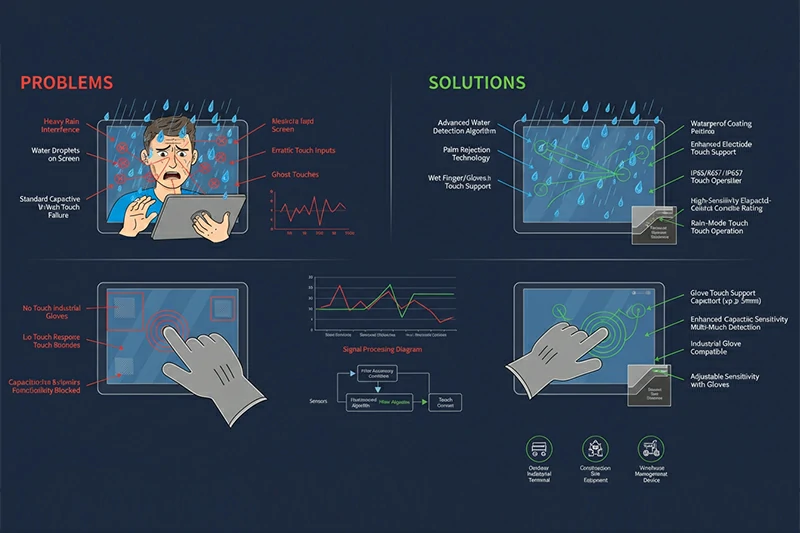
Industrial capacitive touch (CTP) with Goodix, ILITEK, or EETI controllers supports multi-touch, wet fingers, and 19 glove types. Resistive touch is cheaper and works with any stylus or bare/gloved press but lacks multi-touch and degrades with scratches.
| Option | Advantages | Limitations | Best Applications |
|---|---|---|---|
| Capacitive (CTP) | Glove/wet support, multi-touch, durable | Higher cost, tuning needed | Modern industrial/medical HMI |
| Resistive | Low cost, stylus, any glove | No multi-touch, scratch-prone | Legacy, stylus-only equipment |
4. Bonding Comparison: Air-Gap vs OCA Full Lamination
Air-gap assembly leaves a reflective interface between the touch panel and LCM; OCA full lamination fills it with optical-clear adhesive. The difference is measurable: OCA reduces reflectance to ≤2%, raises contrast by 15–20%, and lifts transmittance to ≥90%.
5. Brightness and Sunlight Readability
TFT LCD industrial modules reach 800–1500 nits with ≥1000:1 contrast. Readability in direct sun depends on both nits and reflectance. A 1000-nit module with an air gap can still wash out; the same module with OCA bonding and ≤2% reflectance stays legible. Always specify the pair together.
6. Cost-of-Ownership Trade-Offs
Lower panel price can be offset by EOL redesign, field returns from glare or delamination, and requalification. OCA bonding and BOM-lock/PCN discipline cost more upfront but protect a 5–10 year program. The manufacturing and supplier view—including cleanroom controls, BOM lock, and PCN—is detailed in the manufacturing and supplier selection guide.
7. Decision Rules
- Long-life industrial/medical/automotive HMI → TFT LCD with BOM lock and PCN.
- Direct sunlight → TFT LCD 800–1500 nits + OCA bonding.
- Noisy, long-cable factory → LVDS interface.
- Legacy stylus-only → resistive touch acceptable.
- Short-life premium visual → evaluate OLED with burn-in mitigation.
Conclusion
TFT LCD is the default for demanding, long-life HMIs because of its brightness, temperature range, and supply stability, while OLED and TN serve narrower niches. Match the interface to EMI and cable constraints, choose capacitive touch for modern gloves/wet use, and require OCA bonding for any sunlight-exposed device. For the broader decision map, return to the TFT LCD module buyer’s guide.
Discuss Your Display Stack
If you are weighing TFT LCD against another technology or need an interface-conversion layout, send us your host, EMI, and lifecycle requirements. Our engineering team will review your display stack and return a technical recommendation with a sample evaluation plan and quotation. You can also explore the TFT LCD Display Module capabilities before sending your inquiry.
Frequently Asked Questions
Is OLED better than TFT LCD for industrial use?
Not usually. OLED’s burn-in and supply-longevity risk make it poor for 5–10 year programs. TFT LCD is preferred for industrial HMIs because of stable supply, brightness, and temperature range.
Does higher nits always mean better sunlight readability?
No. Readability also depends on reflectance. A high-nit panel with an air gap still glares; pair 800–1500 nits with OCA bonding (reflectance ≤2%) for true outdoor legibility.
When should I use LVDS instead of MIPI?
Use LVDS for longer cables and noisy industrial environments where differential signaling reduces EMI. Use MIPI when the host processor natively outputs it and board space is tight.
Is resistive touch obsolete?
It is not obsolete for legacy, stylus-only, or extremely cost-driven designs, but capacitive touch is recommended for modern multi-touch, glove, and wet-hand operation.
What does OCA bonding cost versus air-gap?
OCA adds process cost (cleanroom lamination, debubbling, UV cure) but reduces field returns and improves contrast 15–20%, lowering total cost of ownership for outdoor equipment.
Can I convert HDMI or VGA to a TFT module interface?
Yes. Custom interface-conversion layouts (HDMI/VGA to LVDS/MIPI) are supported, with engineering drawings returned for approval within 3–5 business days.