For industrial, medical, and automotive programs, the display module’s manufacturing process and the supplier’s lifecycle policy determine whether your product ships reliably for 5–10 years or faces forced redesign. Bonding quality, cleanroom control, BOM lock, and PCN discipline are the difference between a stable supply and an emergency requalification. This guide explains what to verify on the production floor and in the supplier contract before you commit.
Table of Contents
- 1. Why Manufacturing Process Drives Field Reliability
- 2. OCA Full Lamination and Optical Performance
- 3. Cleanroom and Lamination Equipment Specs
- 4. Capacitive Touch Stack and Tuning
- 5. BOM Lock, PCN, and Longevity Framework
- 6. Low-Volume High-Mix Production Capability
- 7. Certifications and Quality System
- 8. Supplier Evaluation Checklist
- Conclusion
- Qualify Your Display Supplier
- Frequently Asked Questions
1. Why Manufacturing Process Drives Field Reliability
A TFT LCD module looks identical across suppliers on a datasheet but behaves differently in the field. The gap shows up as bubbles, delamination, contrast fade, and touch drift—all rooted in lamination, cleanroom, and tuning discipline. These are manufacturing decisions, not component specs, which is why process capability must be audited directly. The broader selection and comparison logic that feeds these decisions is in the TFT LCD module buyer’s guide.
2. OCA Full Lamination and Optical Performance
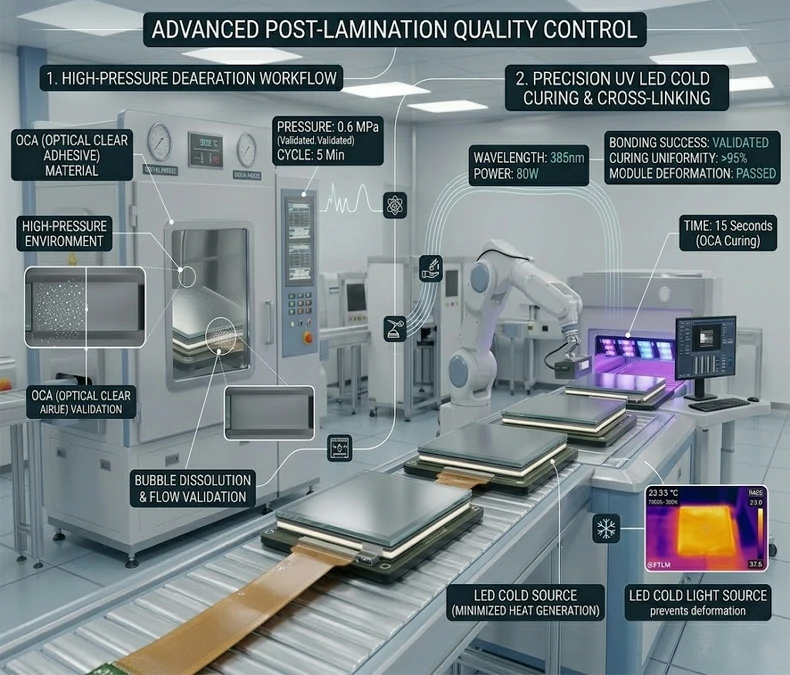
OCA (Optical Clear Adhesive) lamination is the core of industrial TFT LCD displays, as described on the Goldconn TFT LCD Display Module page. By eliminating the air gap between the touch panel (CTP) and the display (LCM), it reduces surface reflection to ≤2% and improves contrast by 15–20%. Light transmittance reaches ≥90%, preserving color accuracy while improving sunlight readability and viewing-angle performance.
3. Cleanroom and Lamination Equipment Specs
All bonding is performed in an ISO Class 5 cleanroom (≥0.3 μm: ≤10,200 particles/m³; ≥0.5 μm: ≤3,520 particles/m³) at 23 ± 2°C and 65 ± 5% RH, with grounding and ionizer electrostatic protection. Equipment controls are specific:
| Process Step | Control Parameter | Why It Matters |
|---|---|---|
| Alignment | ≤200 μm accuracy | Prevents offset and edge bonding defects |
| Vacuum lamination | ≤−95 kPa | Removes trapped air before cure |
| High-pressure debubbling | ≤0.6 MPa autoclave | Eliminates residual microbubbles |
| UV curing | 365 nm, adjustable power | Controlled cure with LED cold source |
Ask suppliers for their cleanroom class and alignment/debubble numbers; vague answers correlate with higher field-return rates.
4. Capacitive Touch Stack and Tuning
Industrial CTP uses premium ICs (Goodix, ILITEK, EETI) tuned for high signal-to-noise ratio to support wet-finger tracking and 19 industrial glove types. The stack is specified as CTP thickness 1.2–2.5 mm, ITO sensor layer 100–150 nm, on 0.55/0.7/1.1 mm substrates. Cover-lens hardness reaches ≥9H or ≥9.5H, with lens thickness 1.0–6.0 mm (up to 10 mm) for vandal-resistant enclosures. The controller and tuning choices that determine glove and wet-hand behavior are covered in the TFT LCD module selection guide.
Touch performance is an engineering result, not a default. Require documented glove/wet-hand test results rather than a controller-IC name alone.
5. BOM Lock, PCN, and Longevity Framework
For long-life products, the supply policy is as important as the panel. The industrial supply program locks core components: native liquid-crystal glass substrate, driver ICs, touch-sensor pattern design, controller chipsets, and polarizer materials. If an EOL event occurs, the supplier issues a formal PCN notice 6–12 months in advance and secures a pin-to-pin compatible alternative. A 5–10 year longevity framework is backed by written availability commitments. The cost and trade-off side of these policies is compared in the TFT LCD comparison guide.
6. Low-Volume High-Mix Production Capability
Industrial automation, rail transit, and medical monitoring devices run on lower-volume, highly customized profiles. Lines with quick-changeover tooling manage low-volume mass-production batches after prototype sign-off. Custom AD control boards and initial prototypes follow a defined timeline: official engineering drawings for approval within 3–5 business days, and functional hardware prototypes typically within 3–4 weeks.
7. Certifications and Quality System
Manufacturing operates under audited quality frameworks certified to ISO 9001 and IATF 16949. Panel supply is secured through direct allocations with Tier-1 manufacturers—BOE, AUO, Innolux, HannStar, IVO, and Tianma—which stabilizes structural-component availability for long programs. MTBF exceeds 50,000 hours under specified industrial conditions.
8. Supplier Evaluation Checklist
- ISO 9001 and IATF 16949 certification on file.
- ISO Class 5 cleanroom with stated alignment (≤200 μm) and debubble (≤0.6 MPa) controls.
- OCA bonding with reflectance ≤2% and documented contrast gain.
- BOM lock covering glass, driver IC, touch pattern, controller, polarizer.
- Written PCN 6–12 months and 5–10 year longevity commitment.
- In-house AD-board and CTP development with 3–5 day drawing turnaround.
- Tier-1 panel allocations (BOE, AUO, Innolux, HannStar, IVO, Tianma).
- Low-volume high-mix tooling for medical/test equipment volumes.
Conclusion
Specify the module on process and policy, not just on the datasheet. Require ISO Class 5 bonding, OCA lamination with ≤2% reflectance, documented glove/wet touch tuning, and a BOM-lock plus PCN framework that protects your 5–10 year production window. Use the checklist above during supplier audits and RFQs, and verify each claim with documentation rather than a quotation line. The discipline you enforce at supplier qualification is what prevents field returns and emergency requalification later.
Qualify Your Display Supplier
If you are auditing a module partner for a long-lifecycle program, send us your qualification requirements. Our team will share cleanroom, bonding, and lifecycle documentation, and return custom AD-board drawings within 3–5 business days. You can also review the TFT LCD Display Module capabilities and send your inquiry for sample evaluation and quotation.
Frequently Asked Questions
What cleanroom class is needed for OCA bonding?
ISO Class 5 is used for industrial OCA lamination to minimize micro-particle defects. Combined with ≤200 μm alignment and ≤0.6 MPa debubbling, it protects yield and long-term reliability.
What does BOM lock actually cover?
It locks the glass substrate, driver ICs, touch-sensor pattern, controller chipset, and polarizer. This prevents silent substitutions that would change optical or electrical behavior of your certified product.
How long does a custom prototype take?
Engineering drawings for approval are provided within 3–5 business days; functional hardware prototypes typically ship within 3–4 weeks after design confirmation.
Why does IATF 16949 matter for non-automotive products?
It signals a stricter, automotive-grade quality system. Even for medical or industrial HMIs, it indicates disciplined change control and traceability that reduce field risk.
Can low-volume orders be produced reliably?
Yes. Quick-changeover tooling supports low-volume high-mix batches after prototype sign-off, which suits industrial automation, rail transit, and medical monitoring equipment.
How is glove and wet-hand touch verified?
Through high-SNR tuning of Goodix/ILITEK/EETI controllers, validated against 19 industrial glove types and wet-finger tracking. Request the test report rather than relying on the IC name.